The Deck

Once again I was thinking about those well cut planks of wood covering the deck of ancient voyaging canoes. At least this is what it seems to be when looking at some paintings, especially those by Herb Kane. I already stated in a prior comment that I strongly believe that the Polynesian people were capable to cut planks, or at least to have knowledge of species of wood that can be easily split with the help of wedges in order to make planks. Lets have a quick look at an ancient Hawaiian fishing canoe: there is the hull which is carved out of a tree log, than there are the two tops or manus, often carved out from the foot of the Ahakea tree, than we have the outriggers for which Hau was the ideal flexible wood ; for the ama or float wili wili was used for its buoyancy, but the canoe would not be seaworthy without the addition of rims or gunwales to the top of the hull, and see here, those are the only parts of the canoe that are actually planks of wood cut out from the Ahakea tree, which is a wood that splits very easily.

The Ahakea is a fairly short tree, reaching a maximum height of 30 to 35 feet. There is no doubt in my mind that the Polynesians, or for that matter all the people of Oceania not only had a profound knowledge of their environment but also knew how to use it to their advantage with the least of efforts. If in today’s world we equip ourselves with a multitude of tools to fashion a little bench or mount a shelve, it was nature which provided the necessary material to the Oceanic people to build canoes using only an adze, sennit, and their knowledge of the flora of their islands.

Now having said that, how could they fashion 80 to 90 feet long planks ? What species of wood could they have been using that splits easily along its grain ? Would there have been a tree of that size available on the Marquesas ? To my knowledge, the Albizia lebbeck was and still is the tallest tree available on those islands but not really suitable for the making of planks.

So my question is whether the deck of those long ocean going voyaging canoes were covered with 80 to 90 feet long planks, and if yes what kind of tree would they have been using for this? Could it be that the deck was made with another material, or by adding length of planks until all the beams were covered ? I truly can’t believe in the latter as it would have made any double hull canoe extremely dangerous to sail.
The Amatasi Canoe

My first comment regarding this canoe dates back 12/5/07 and when writing it I really thought to have the canoe finished by the following day.

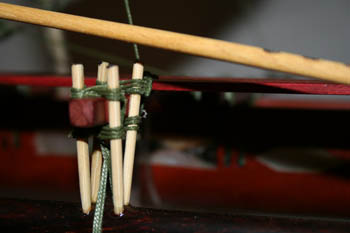
I should have known better. Indeed it took me a few more days to finish the sail and rig the canoe. Has it ever happened to you that you visualize this or that project you intend to do and in your mind things look pretty easy ? Like changing a faucet…piece of cake…or the door lock. no sweat…and you find yourself battling with tape measurer, screw drivers and chasing a ton of other tools and appliances down the nearest hardware store over a few hours, even days? Well, I may have all the tools necessary to build ship and canoe models, and still it took me another 5 days to finish the darn canoe. The trouble started when having to lash the counterweight boom to the hull. When making a model, assembling steps have to be done in a very chronological way. If not, one will loose enormous amount of time working around things were space to use tools is at a premium ! I had also forgotten to install the mast step prior to lash down the beams. Also, the rigging of the sail was much more difficult than what I had imagined. All those difficulties added up and it took me 5 more days to finish the model. I was very happy with the end result but would not like to do a similar model. It will stay one of a kind.

Mayhem in Paradise

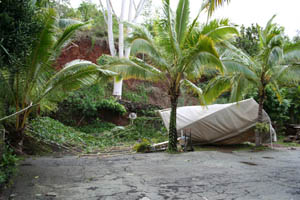
After the sunshine, the rain. In all my many years living in Hawaii, this is the first time, and I admit this readily, that I got scared. It all happened overnight, towards 3.00 AM. The wind suddenly picked up, doors started slamming, gusts of wind rolled down the valley like a thunder, whistling through the palm trees and our big albizia back in the yard. I could hear branches snapping off, empty buckets flying around the yard, and sheets of water falling from the black sky. The house was shaking. Blackout……

Where’s the flashlight, the emergency box. It was not the wind that scared me, or the thunder or lightning’s. But the visualization of this 110 foot albizia tree toppling over and falling over our house. It’s only a few days ago that I witnessed another albizia tree been uprooted by strong winds. The storm receded towards 4. 00 AM but the fright it created so suddenly would not let me go to sleep again until daylight, and when daylight came, things had moved, other things had come down and the entire valley looked like having been stricken by a hurricane. It became another long day in paradise without power, internet connection and what not.