HIKIANALIA SCALE MODEL

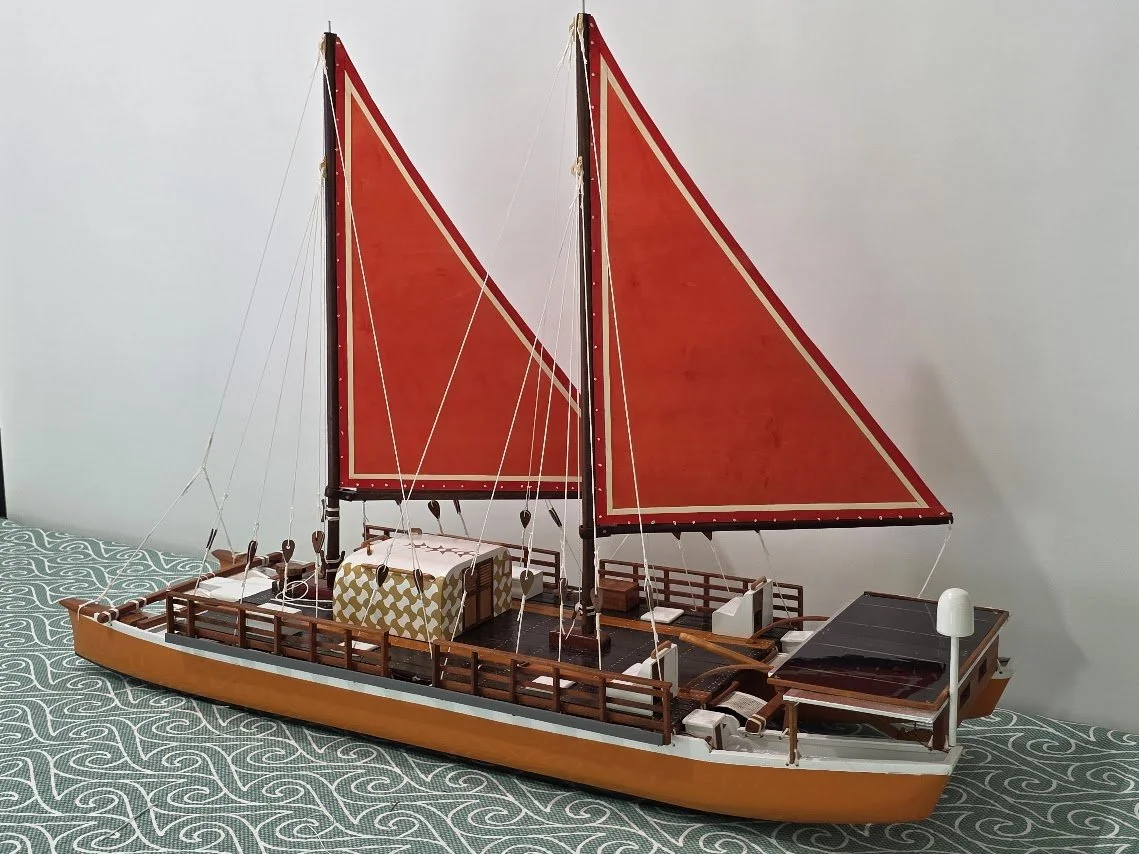
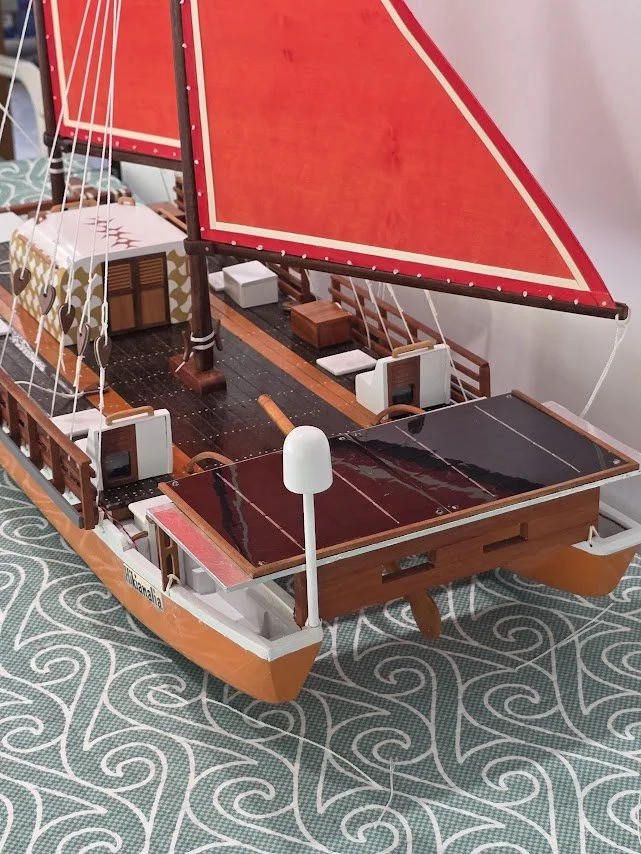
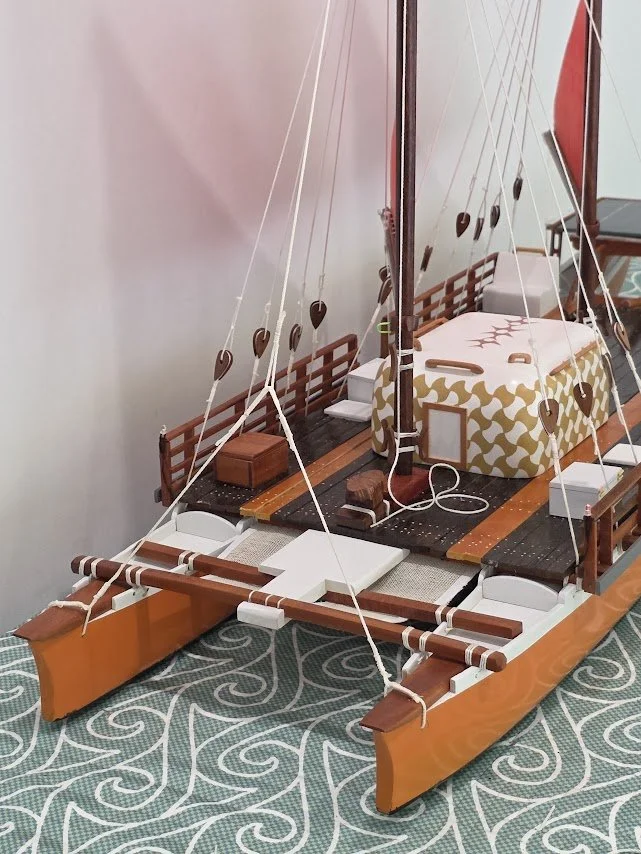
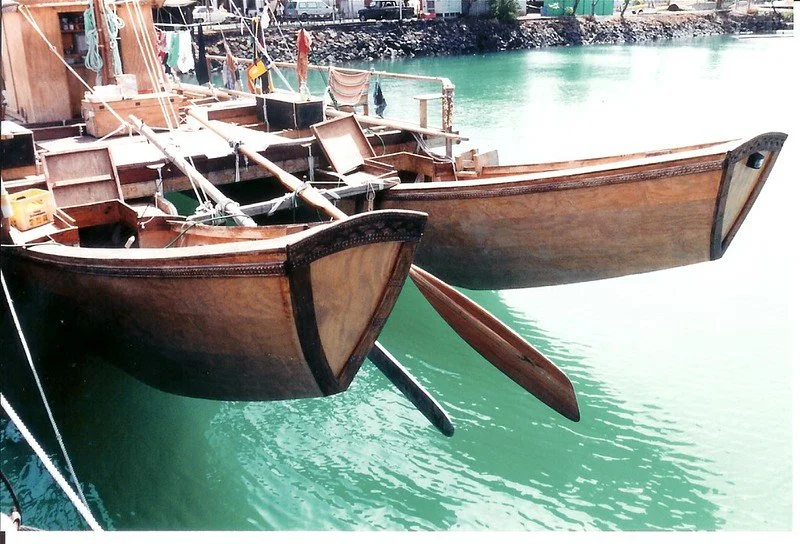
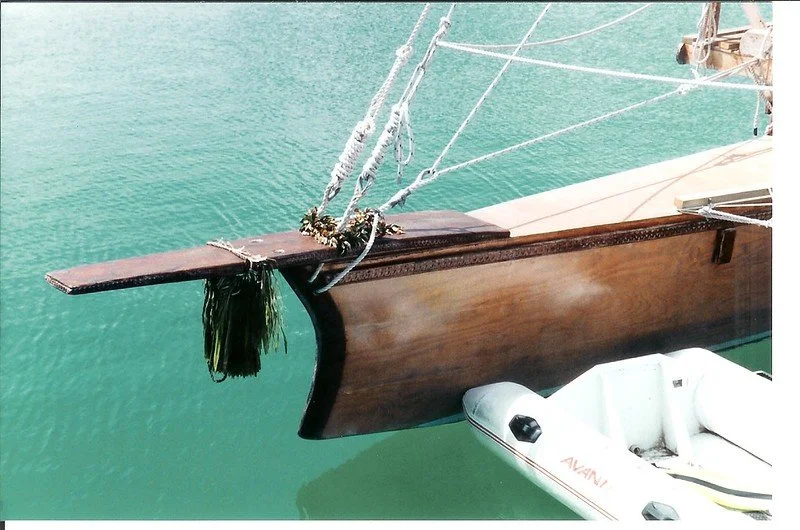
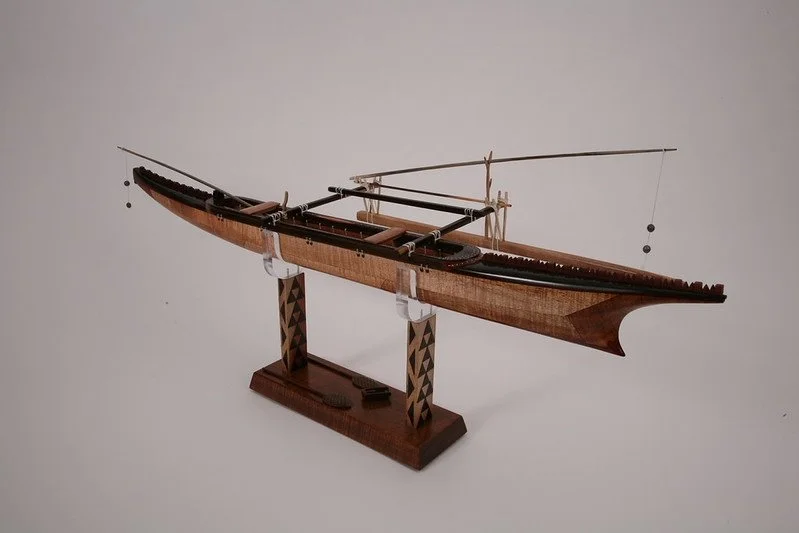
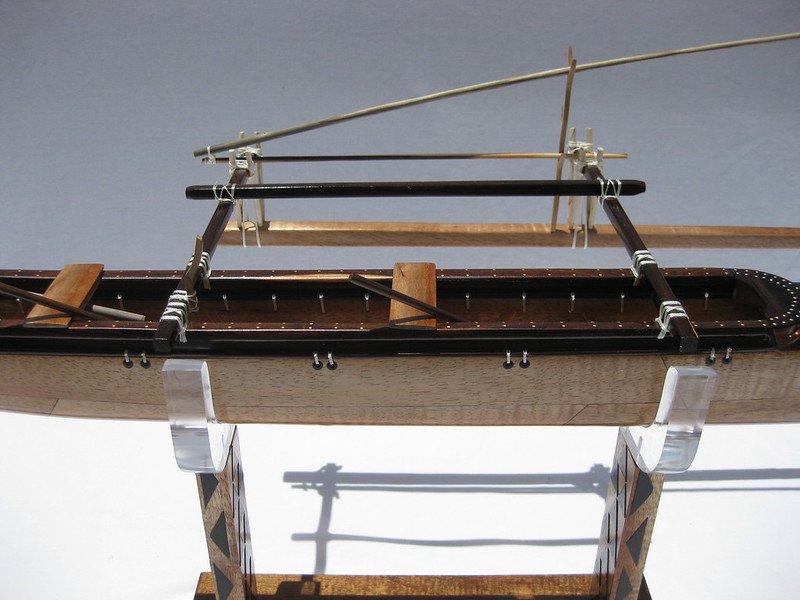
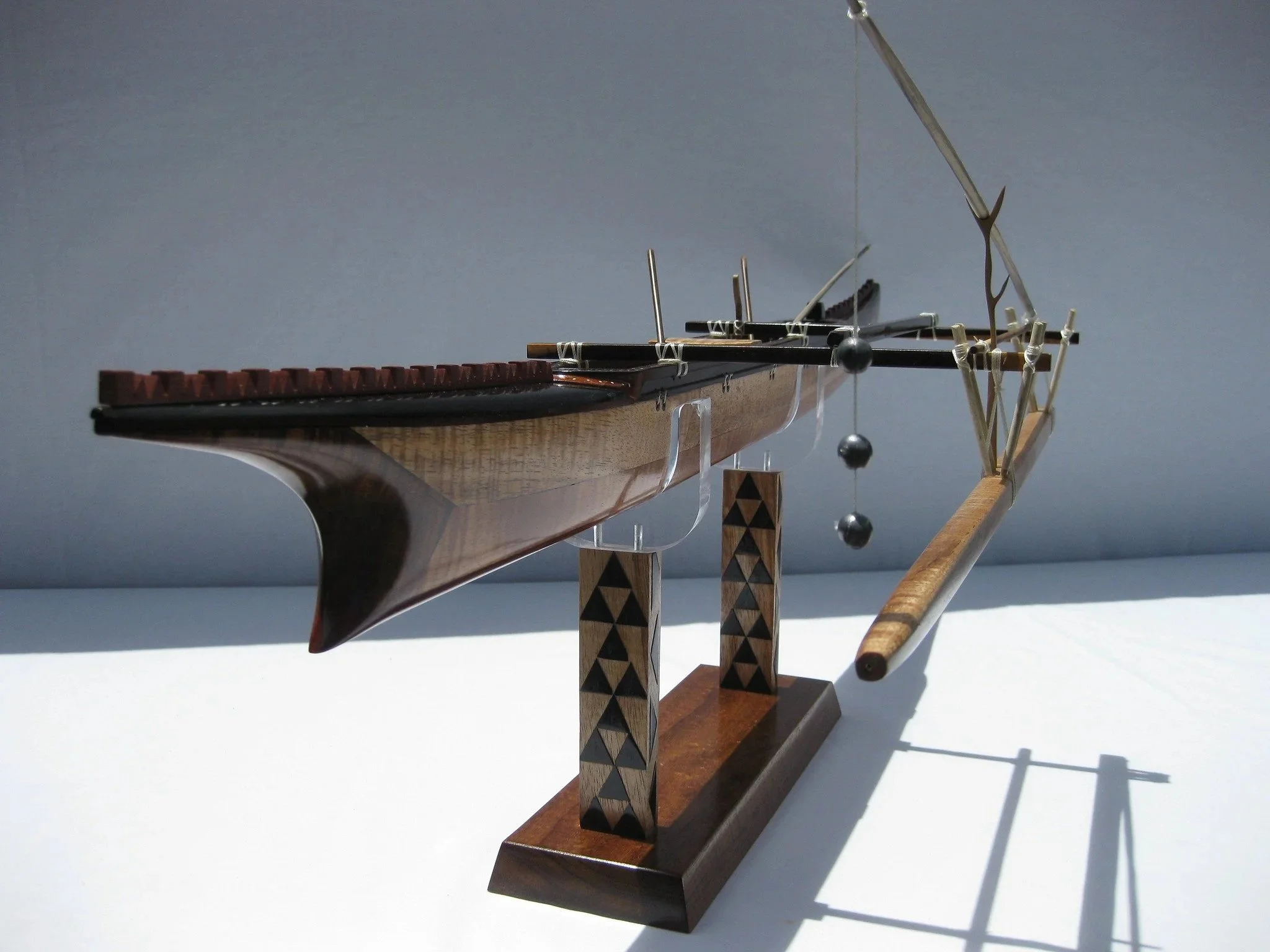
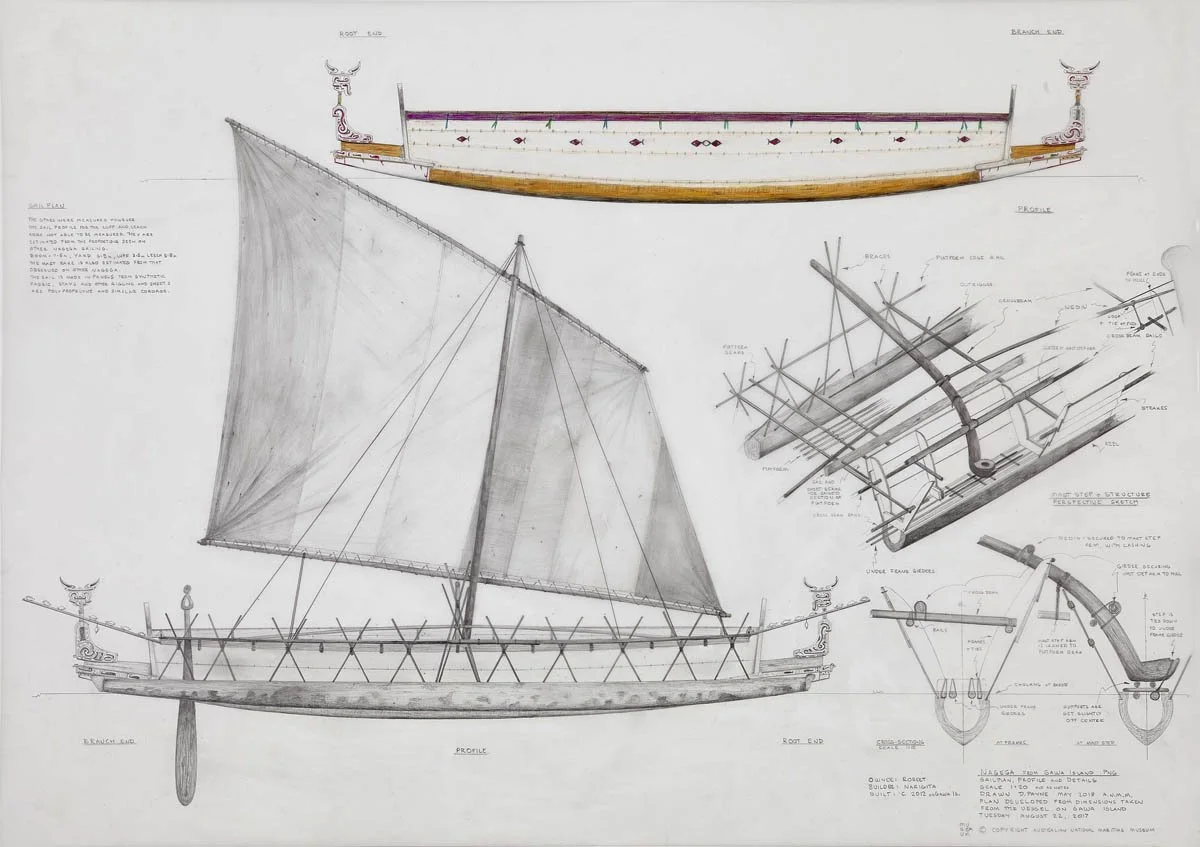
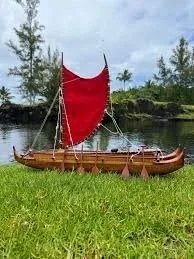
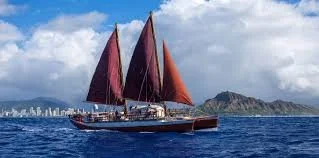
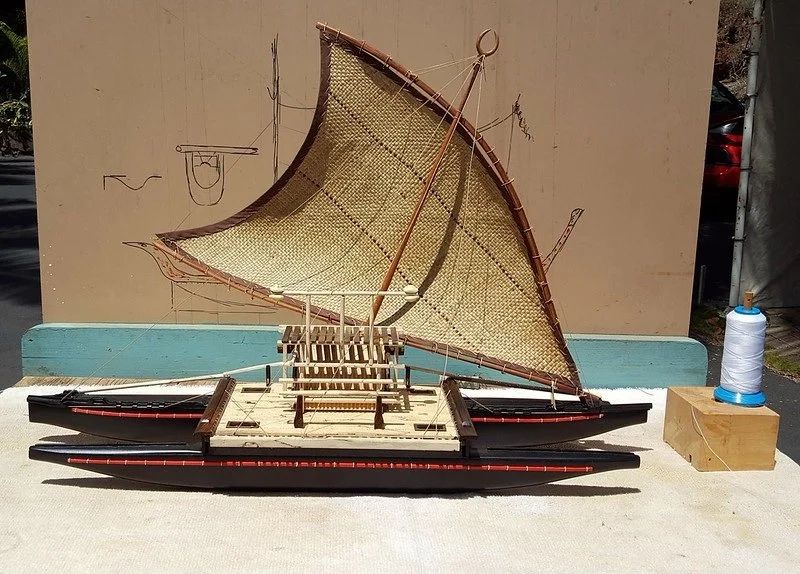
I have recently been commissioned to build a Hikianalia scale model, 32 inches long. For a long time, I was holding back from building a model of it for the simple reason that I consider Hikianalia to be a catamaran, except for the fact that it has a steering paddle rather than a rudder.

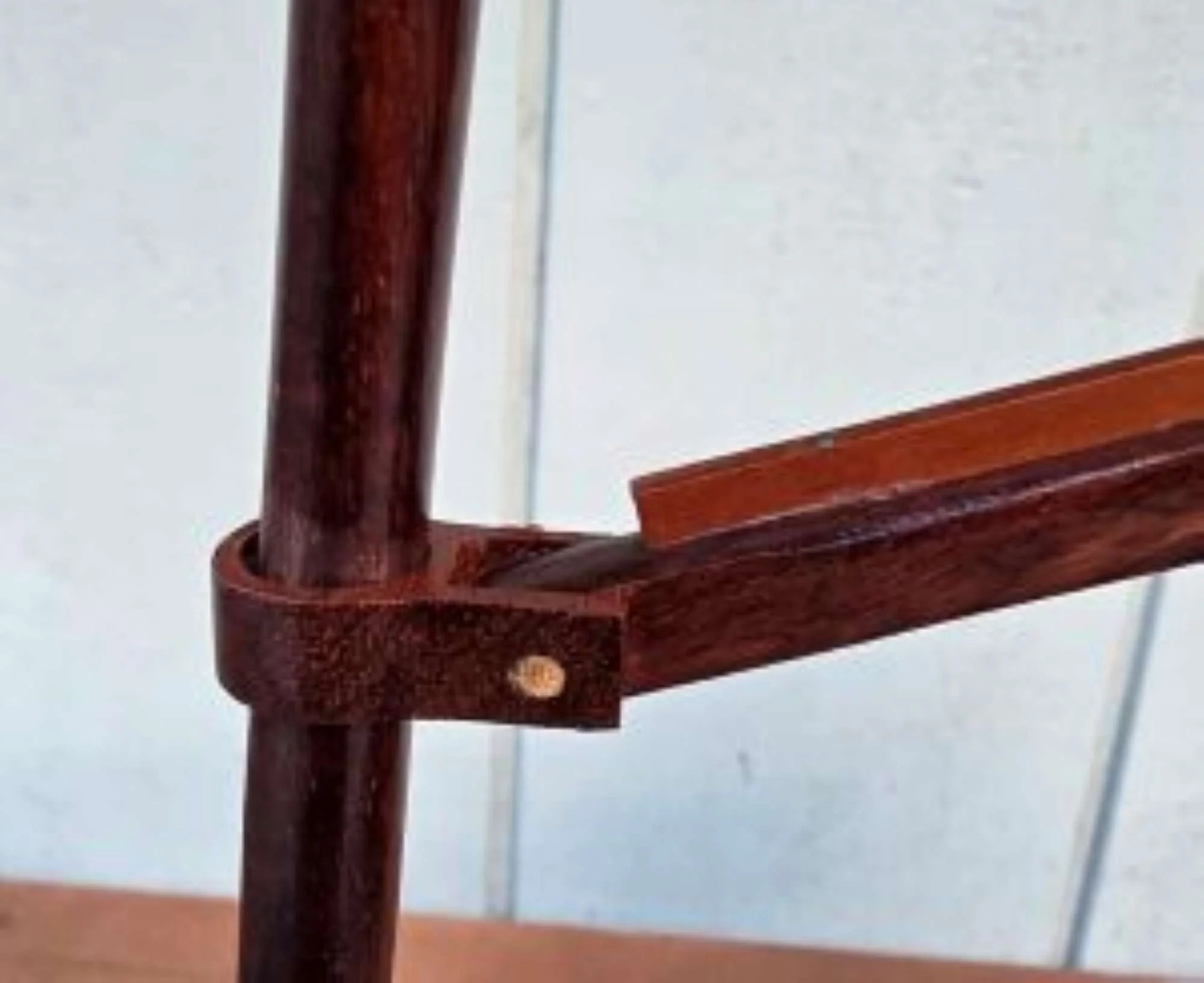
The boom, or horizontal spar attached to the mast of the Hikianalia that secures the bottom edge of the sail, is of extruded aluminum.

I am good at working with wood, but not with metal, so if you know

somebody who loves tinkering with small precision mechanics, let me know.

A RARE FIND

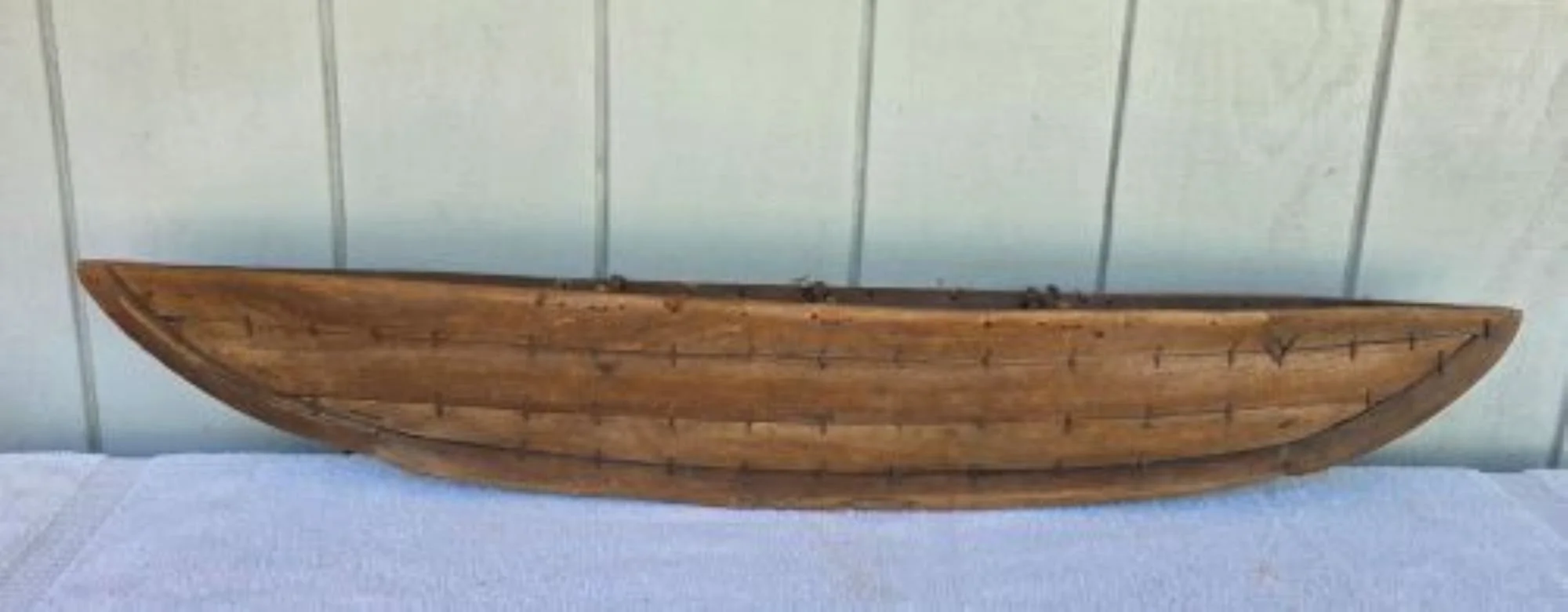
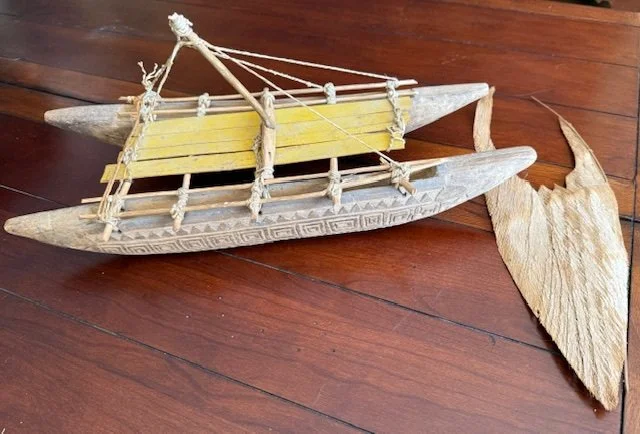
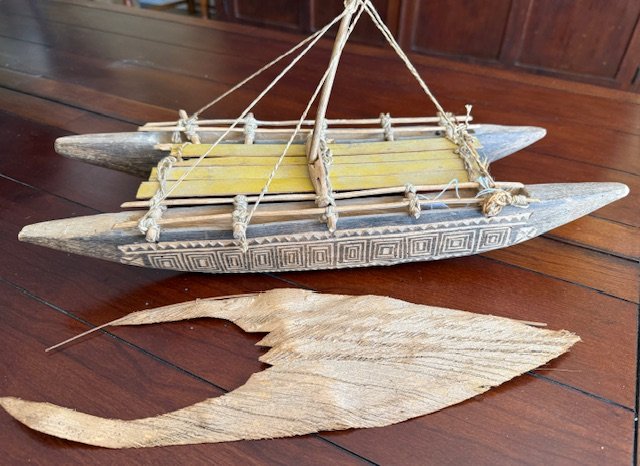
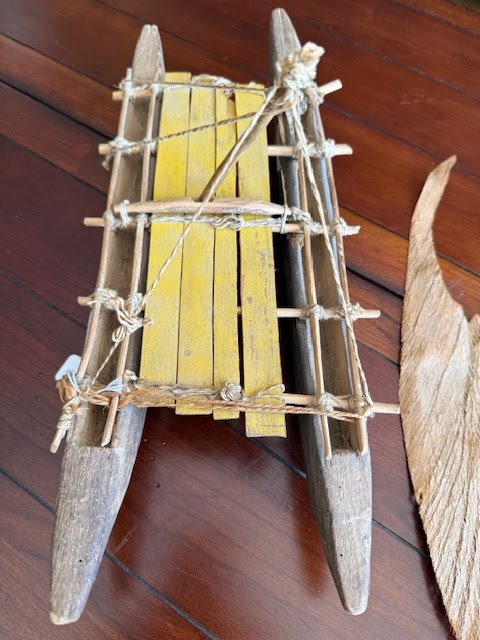
A collector approached me recently, asking whether I could identify the model of an old double-hulled canoe he bought while visiting Tasmania, on the basis of a few pictures.

The collector wondered whether it might be of Tongan or Solomon Island origin.

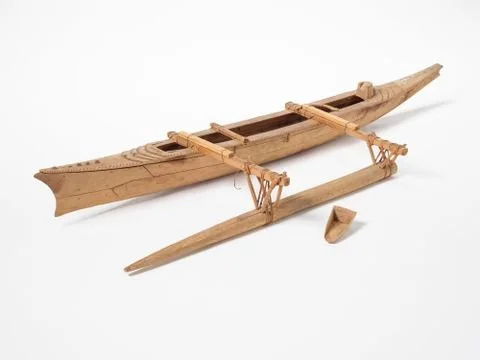
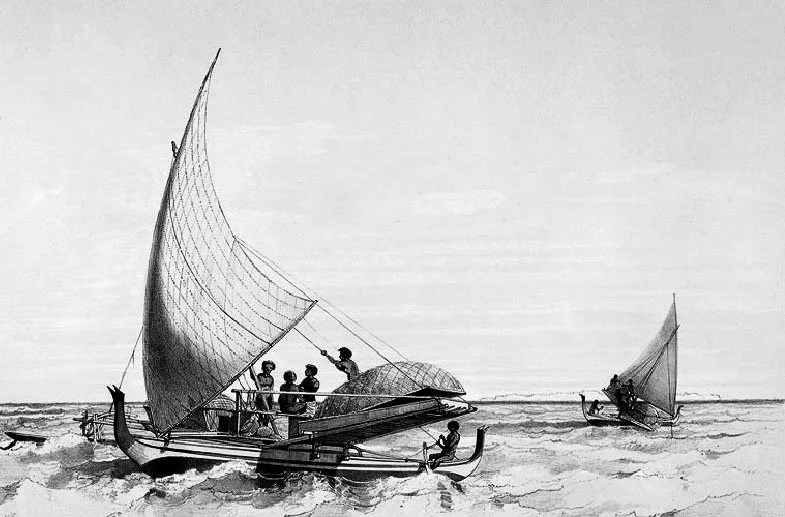
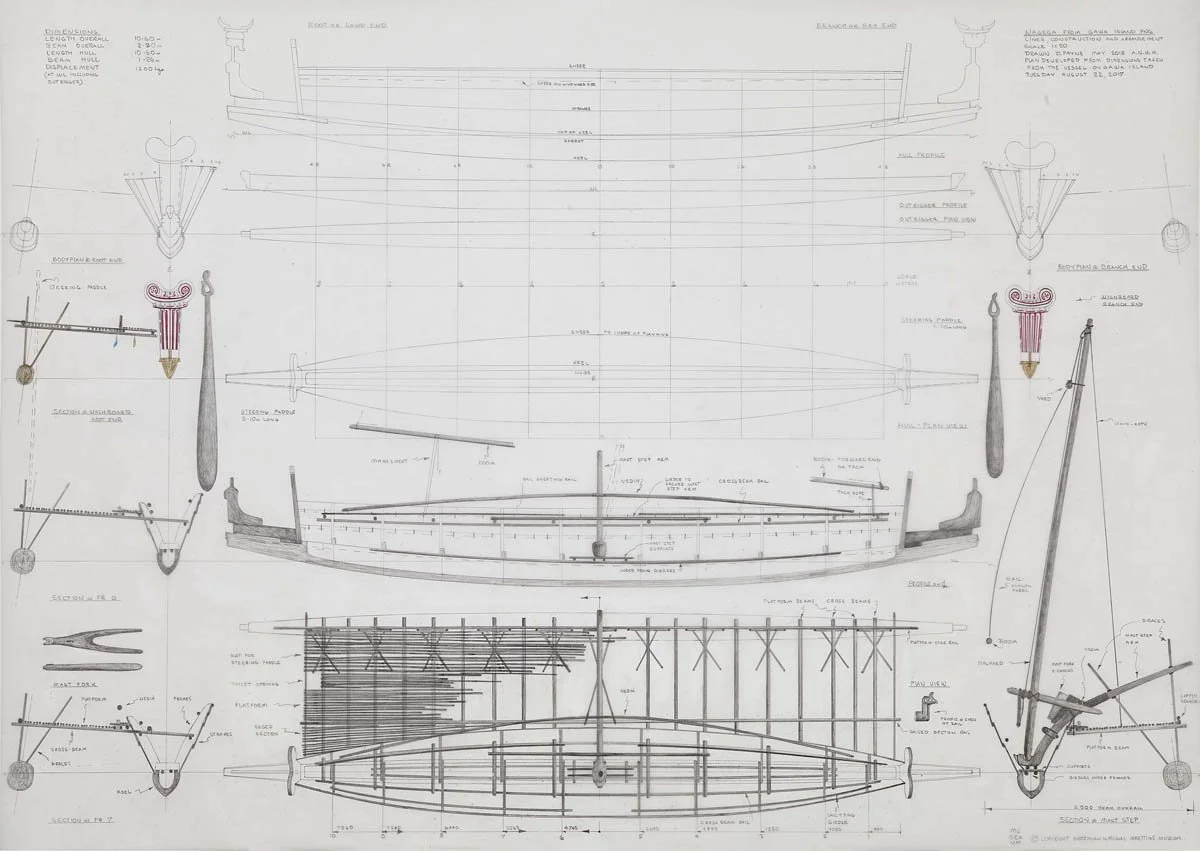
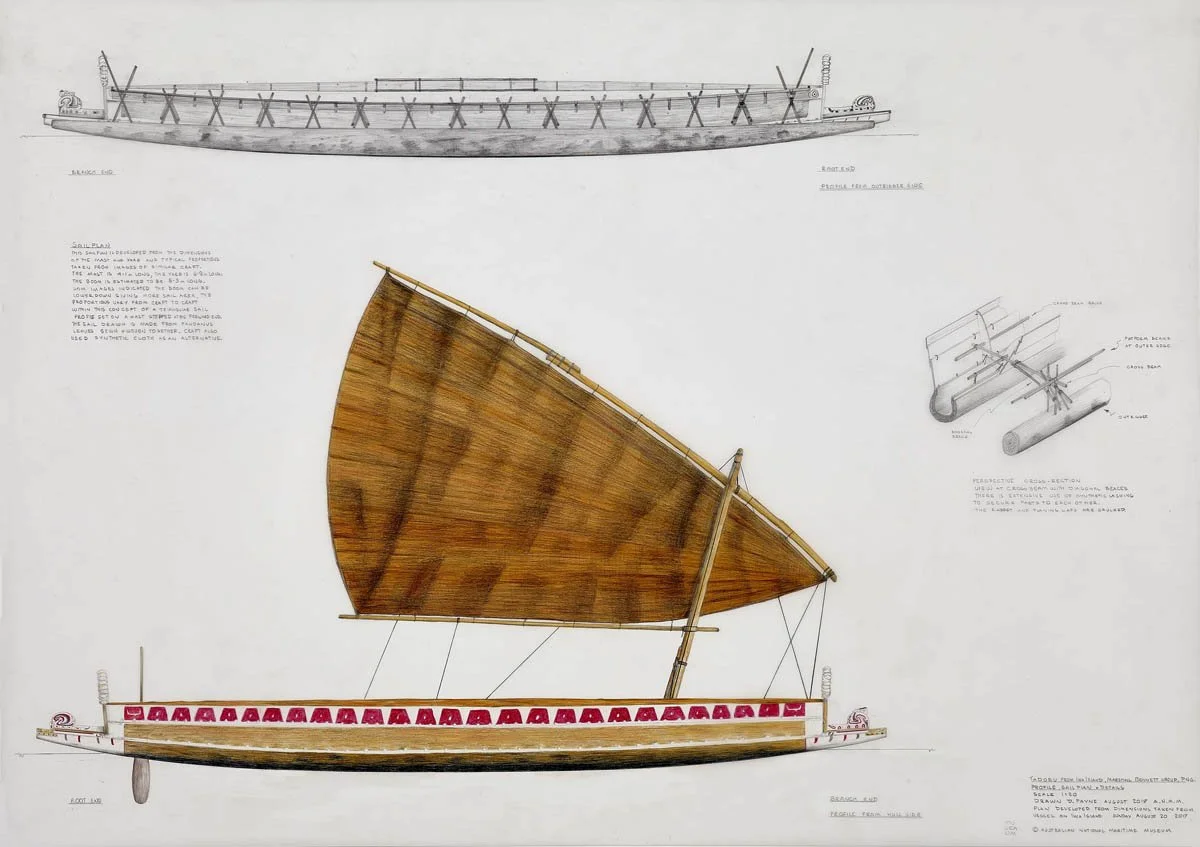
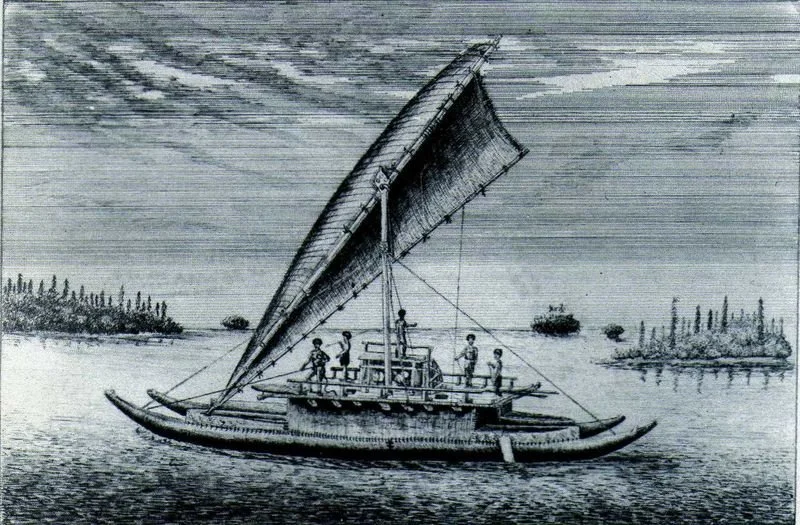
Looking at the type of sail, I could tell that it was definitely not of Polynesian origin. It was a Melanesian-type sail, but not Solomon Islands either. The tribes along the South-West coast of PNG were rigging their canoes with this triangular type of sail. Those tribes were the "Motu" and the "Roro". It was a type of canoe observed by A.C. Haddon and mentioned in his work 'Canoes of Oceania", page 226.

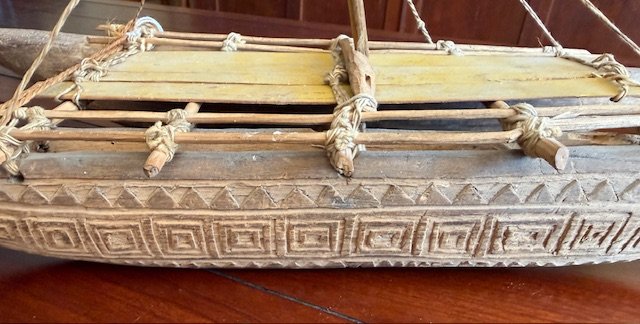
A few double-hulled canoes have been observed with ligated gunwales on the upper edges of the hulls, which is an exceptional technique in this region. This technique has been implemented on this model.

The Roro name for this type of canoe was "ahi rua iviri."

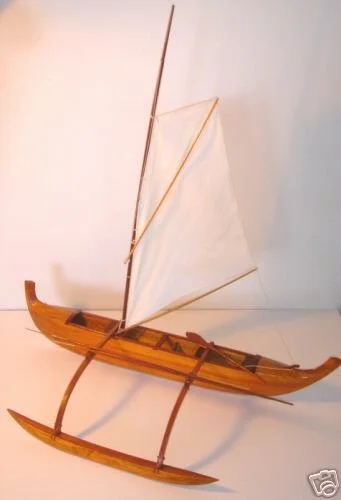
Single sail Papua New-Guinea canoe model

TRIANGULAR MELANESIAN SAIL

LIGATED GUNWALES AND ‘MOTU’ TYPE (PNG) ENGRAVED DESIGNS

A “AHI RUA IVIRI” CANOE MODEL
Philippes Banca: the Southern Migrations

In the South (Mindanao and the Sulu Archipelago, the migrations from the Celebes (Sulawesi) and the Moluccas introduced different designs. The sea-nomadic cultures like the Bajau and Sama-Bajau drove this.

Key features:

The V-Shaped hull: Southern vessels often feature a sharper, deeper V-shape compared to the flatter northern hulls, allowing them to “slice” through the Celebes Sea.

The Lepa-Lepa: A masterpiece of the south. The Lepa is mostly built from a single log of wood, but in some cases “plank-built”, and without outriggers, featuring intricate carvings that mirror the art of the Celebes.

The Vinta (Sakayan): Known for its iconic, colorful rectangular sails (Pau), these show a clear stylistic evolution influenced by trade routes connecting the southern Philippines to the Indonesian spice islands.

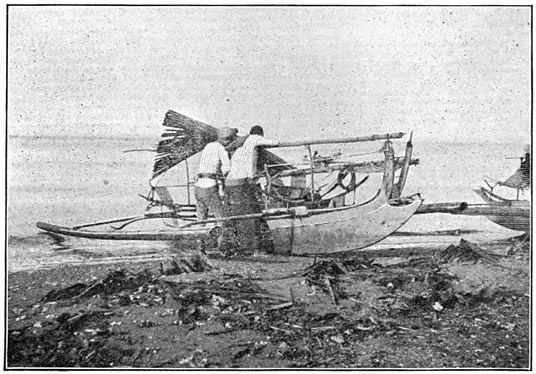
Lepa-lepa canoe from the Bajau people, Philippines

A Moro Vinta canoe from the Philippines/ Mindanao and Sulu sea

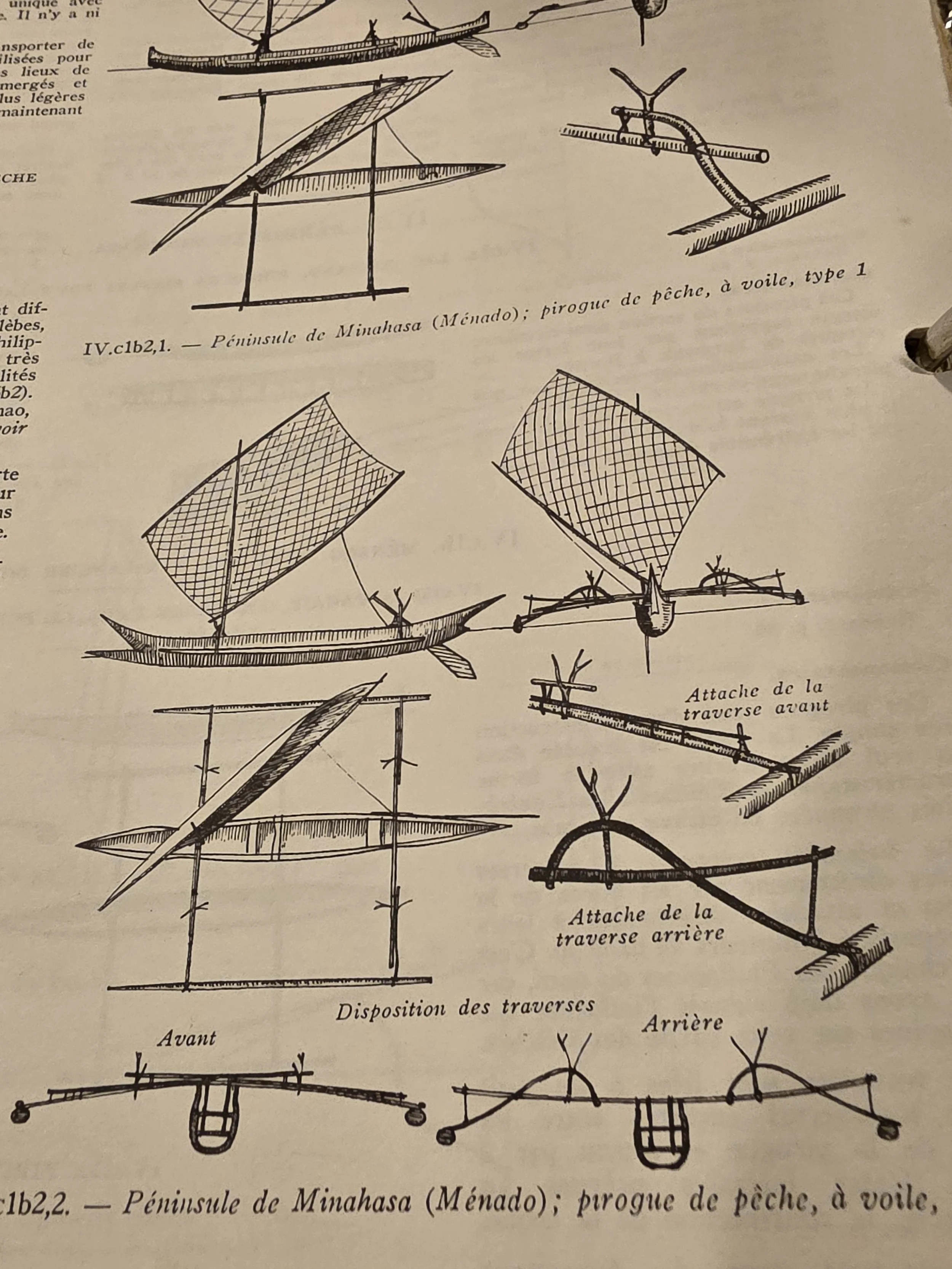
Sketch of a Sulawesi fishing canoe by J. Neyret

Philippines Banca: the Northern migrations

The Taiwan Connection

The migration from Taiwan (the Austronesian Expansion) brought the foundational "Outrigger" technology to the northern Philippines (Luzon) roughly 4,000–5,000 years ago.

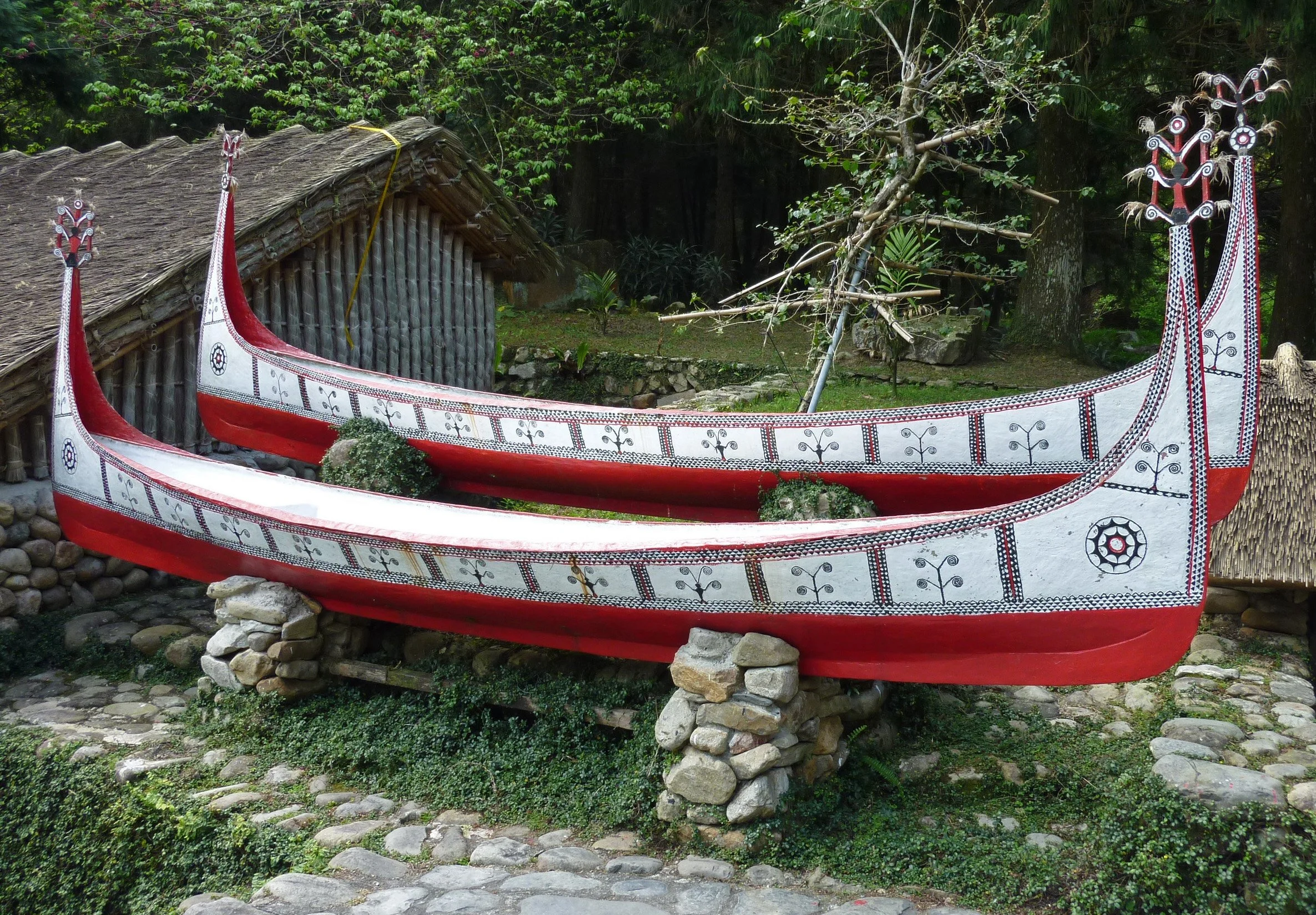
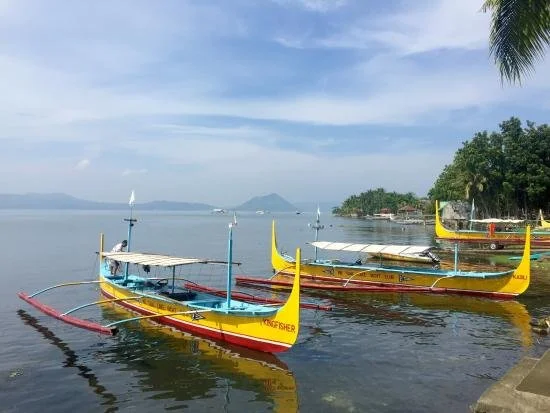
It is interesting to note the characteristics of the Filipino vessels found on lake Taal which resemble those built by the Tao people, or Yami, an indigenous Austronesian ethnic group of people native to Orchid Island off the southeastern coast of Taiwan, which are historically and linguistically linked to the Ivatan people of the Batanes Islands in the Philippines.

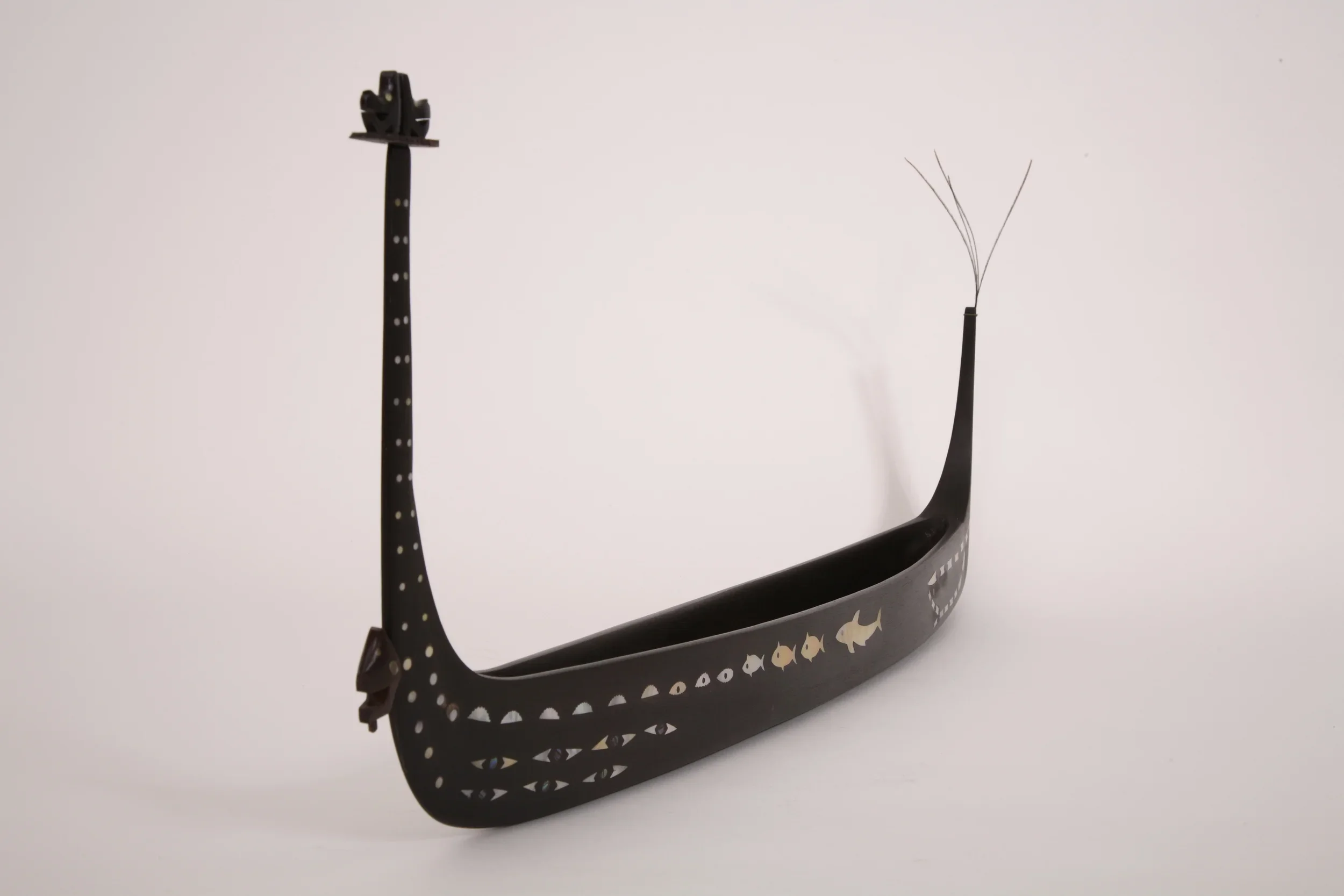
The Tao people are renowned for building traditional, intricately decorated plank canoes, with their rising stern and bow, a type also found in the Moluccas (the orembai) and the "mon" class in the Solomon Islands.

Yami canoe , Orchid Island

Philippines - Lake Taal

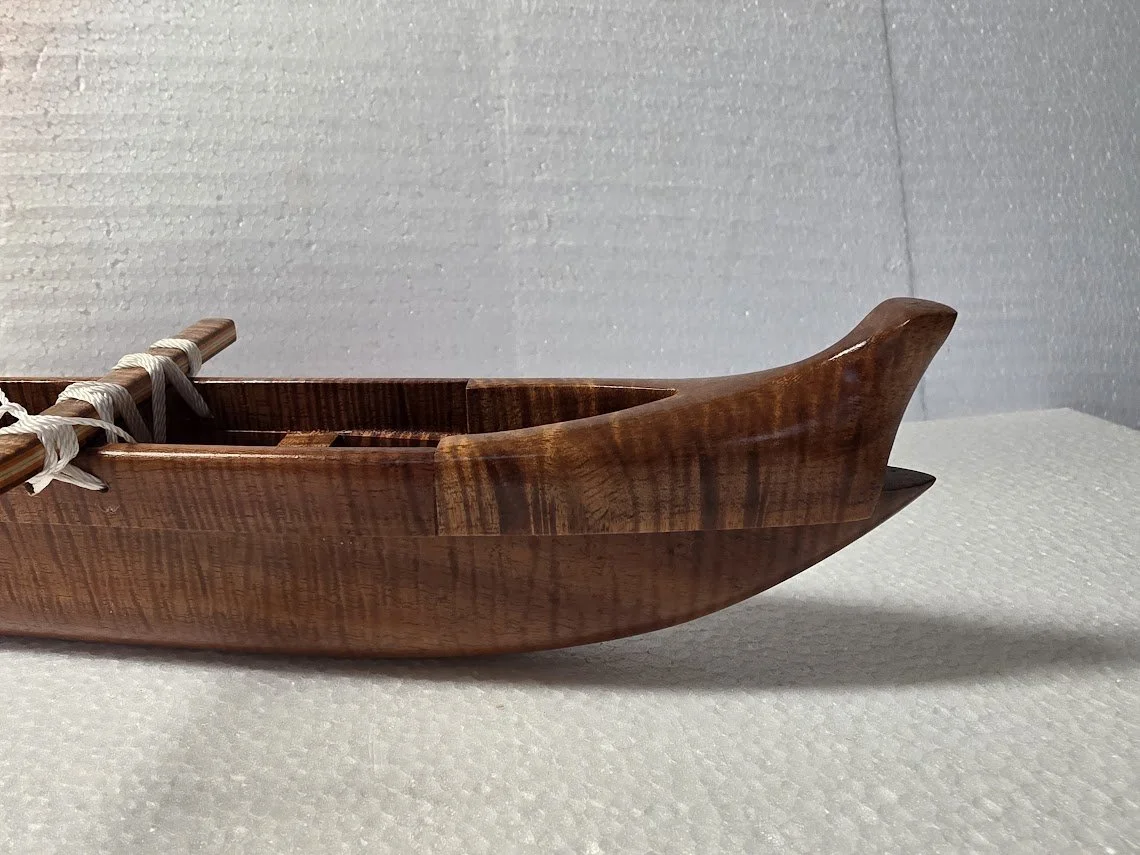
SOLOMON ISLANDS CANOE Model built by the author
THE NAIL-BITING VOYAGE OF THE SARIMANOK

The SARIMANOK voyage was a 1985-1986 expedition led by Bob Hobman, sailing a 60-foot traditional Philippine VINTA (dual outrigger canoe) from Bali to Madagascar to prove that ancient Austronesian ancestors directly crossed the Indian Ocean. The 65-day trip relied on ancient navigation, demonstrating high-level maritime skills.

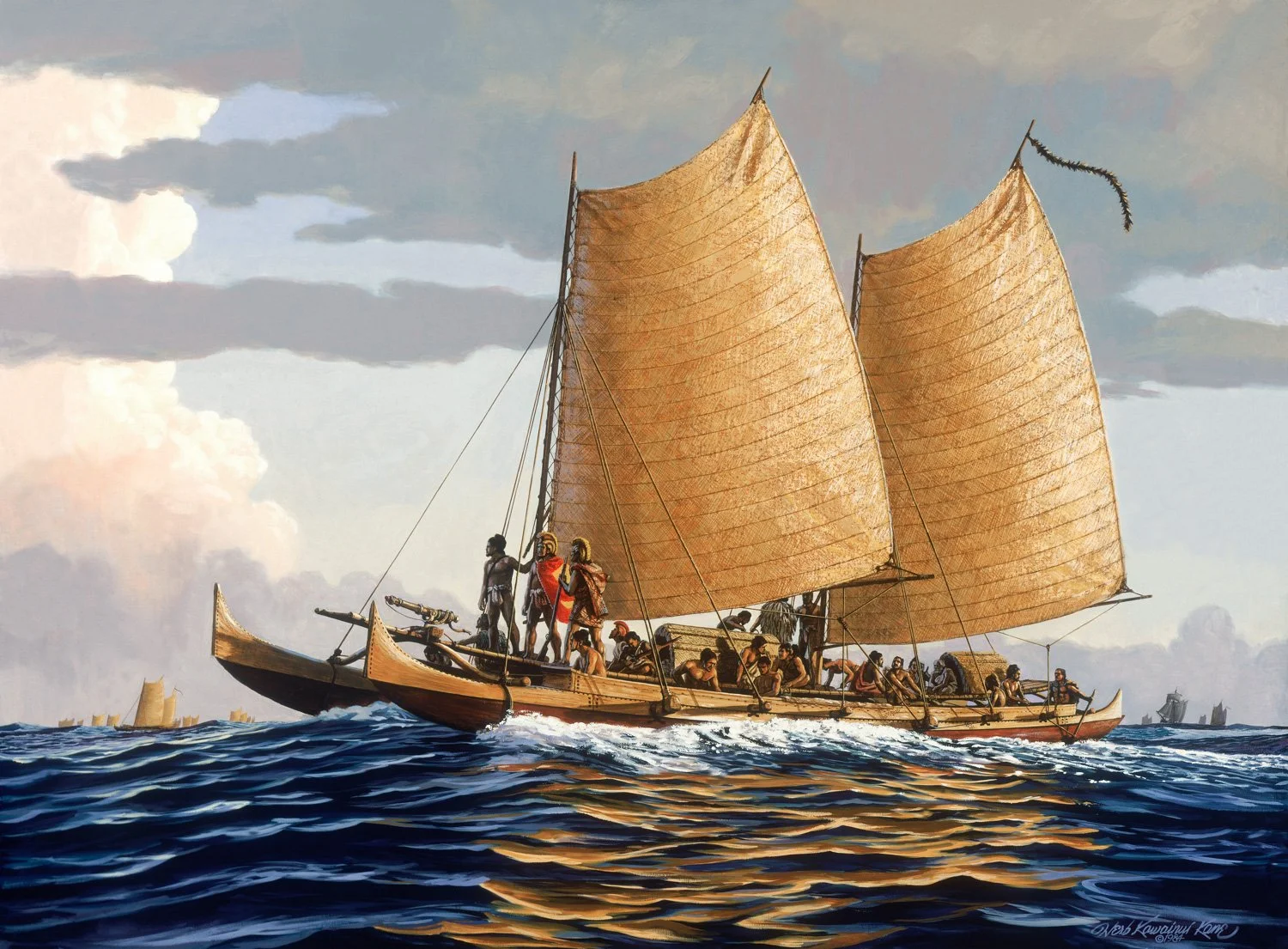
Preceding the expedition of the Sarimanok was the 1976 voyage of the Hokule'a from Hawaii to Tahiti, designed to demonstrate that ancient Polynesian navigators could navigate thousands of miles across the Pacific using traditional, non-instrumental techniques, such as reading stars, ocean currents, and wildlife. This voyage proved that early Polynesian voyagers intentionally settled the Pacific Islands, and not by accidental drift.

SCALE MODELS ARE NO TOYS

The craft of building miniature vessels is often met with a common misconception: that scale models are merely toys or simple shelf decorations. Even among those with salt water in their veins, there is sometimes a tendency to overlook the profound technical history and skill required to shrink a vessel down to size.

For centuries, the scale model was a fundamental stage of maritime engineering. Long before the first plank was laid or a single nail was driven into a hull, shipwrights and master builders constructed "block models" or "builder’s models." These were not for play; they were the primary blueprints. They allowed the builder to study the displacement, the curvature of the hull, and the harmony of the design in a three-wide environment.

In the modern era, this phase has largely migrated to the digital realm. Engineers now use complex 3D software to render every bolt of a car, every rivet of a plane, and every frame of a ship. While these digital twins are efficient, they lack the tactile reality that a physical model provides.

The process of building a miniature by hand—especially one scaled precisely—is a feat of both research and endurance. To do it correctly, the creator cannot simply guess. They must become an amateur historian and a structural engineer, familiarizing themselves with every component of the original craft, from the specific joinery of a Fijian Drua or the intricate lashings on the contemporary Hokule’a to the exact taper of a traditional paddle.

Achieving a high-quality result is a rare combination of technical skill and extreme patience. It is an exercise in "thinking in three dimensions" while working with materials that do not always want to be tamed at such a small scale. Far from being toys, these models are a tribute to maritime heritage and a testament to the meticulous research required to keep that history alive.

To see these principles in practice and explore the craftsmanship of miniature Oceanic vessels, visit Hawaiiancanoes.com

THE MASTER BUILDERS OF THE PACIFIC: The tools that built the Drua.

The tools the Fijian craftsmen used were stone axes for rough cutting, stone chisels (“vilikoi”) and scrapers (“ ai kari”) for shaping, stone wedges for splitting and hollowing logs, and rough lumps of coral or pieces of stingray skin for smoothing and filing. For lighter work they used keen-edged splints of bamboo, sharp shells, spines of sea-urchins, the rough sheaf of the breadfruit; polishing was done by patient friction with pumice and coconut oil. Their only other tools, until the coming of the Europeans, were broken shells or the teeth of rats and fish, fitted with wooden handles. With these crude implements, they felled and split great trees, hewed planks and spars, shaped war clubs.

SYMMETRY OF THE SOUTH SEAS: A short dive into three Iconic Wa'a.

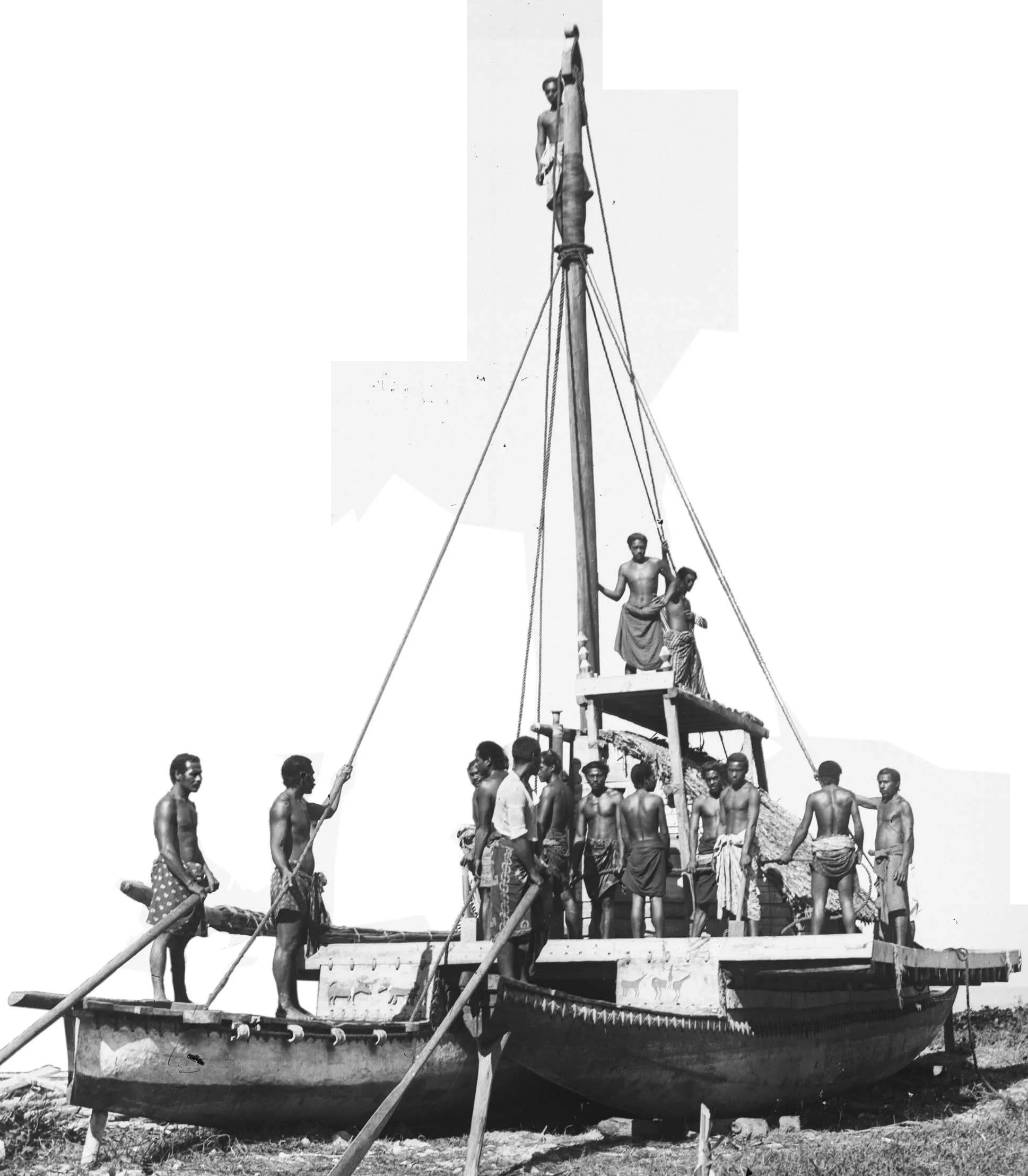
The "ALIA" introduced in Samoa during the 19th century is a Tongan adaptation of the double-hulled canoes from Tonga of the type "KALIA", which in turn have been copied from the Fiji DRUA.

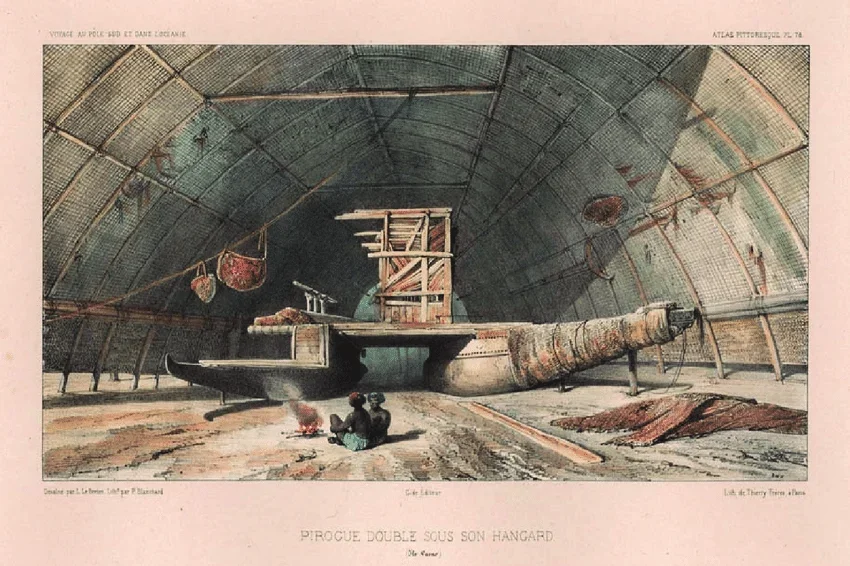
All three types of canoes consist of two hulls of equal length for the "Alia" and "Kalia", but a larger main hull and a smaller outrigger-style hull for the Fiji DRUA, connected by a deck onto which the builders installed a hut covered with great pandanus leaves. The rigging consisted of a lateen sail.

Before the ALIA, there was apparently a predecessor in the name of VA’A TELE of whom we know little except that when changing tack had to be put about the same general way as European sailing vessels, whereby the ALIA, the KALIA, and the DRUA were able to sail forward from either end.

As previously mentioned, the ALIA was a replication of every aspect of the Tongan KALIA and was therefore commonly called KALIA as well. However, the Samoan improved it by introducing the hidden lashing gunwales to the hull. This technique spread to Tonga, where it was used on the TONGIAKI, and to Fiji, where the canoe builders used it in the DRUA. Another interesting detail introduced by the Samoans was the vertical bow at the forward end of the hull, but pointed toward the stern.

It is also worth mentioning at this stage that the Samoans introduced the very concave profile, or clipper bow, at the forward end of their outriggers.

What can be said to the credit of the Samoans is that, from the outset, they were able to build "ALIASES" with a high level of detail and perfection.

The huge canoe that they wanted to offer to Kaiser Wilhelm II, but which could not be transported to Germany because of its large size, was comparative to the most beautiful realizations in Fiji and Tonga, like finstance the RAMARAMA, long by about 100 feet or 30 meters, and transport over 100 people.

A Samoan double-hull voyaging canoe of the type ALIA

The KALIA from Tonga were more advanced, faster, and larger double-hulled vessels, replacing the older, slower TONGIAKI canoe. In use until the second half of the 19th century, when they disappeared, the KALIA’S were precisely similar, in every aspect, to the Fiji DRUA. Actually, the Tongan carpenters built a good number of them in Fiji on the islands of Kambara and Vulanga.

There is also the story of the famous and legendary vessel, the LOMIPEAU, a massive 16th-century Tongan double-hulled canoe, a KALIA, built in Uvea (Wallis Island), which transported heavy lime and basalt stones to the Tu'i Tonga from a faraway island believed to be Wallis.

The Tongans were audacious long-distance navigators, with incursions as far as the Solomon Islands and New Caledonia, in particular the Isle of Pines.

Tongan KALIA

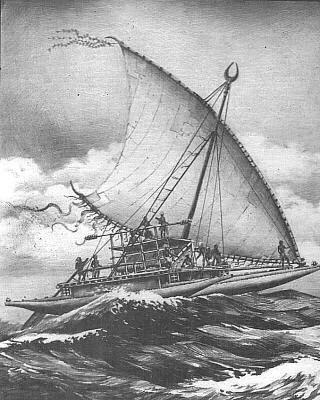
The double-hulled canoes from Fiji, the DRUA, are considered, rightly so, as the masterpiece of Oceanic canoe building. They combined to the highest degree the most enviable nautical qualities: extraordinary speed (15 to 18 knots), cargo capacity, the RAMARAMA, which was long by about 100 feet and could carry 500 men, and very good seakeeping.

The primary advantage of the double canoe is its wide wheelbase, which gives it considerable stability while presenting minimal resistance to forward motion, as the two canoes (hulls) are very narrow: a wide beam of 4 feet for a length of 100 feet, giving a ratio of 1 to 25 between the width and the length whereas in sailing vessels the proportion is generally 1 to 3.

On the other hand, the wheelbase's width allowed the use of a sail that seems truly excessive. The yards of the RA MARAMA were over 110 feet long, the maximum width of the sail reached 78 feet, giving a surface area of over 4000 square feet.

The ALIA, KALIA and Fijian DRUA are arguably the apex of South Pacific canoe-building design and performance, some over 100 feet long and capable of speeds around 15 knots. The question is: what kind of material allowed the construction of such large-hulled vessels? It was the availability of the Vesi loa (Intsia Bijuga) tree, especially in the Southern Lau Group. A spreading tree reaching heights of up to 130 ft. The presence of such trees attracted master craftsmen from Samoa, Tonga, Fiji, and as far as New-Caledonia resulting in cross-cultural exchange to produce the finest voyaging canoes of their time.

It is therefore no surprise that a new type of double-hulled canoe was introduced to Pine Island (New-Caledonia) by visitors from Tongatapu or Haapai, who were hardy navigators. This type of canoe is an integral copy of the Fijian DRUA adopted by the Tongan. One interesting particularity is the shape of the hull's extremities, which end up pointed or slightly rectangular. The cover at both ends of the main hull (tau) was of a more simplified construction than the intricate pieces on the DRUA.

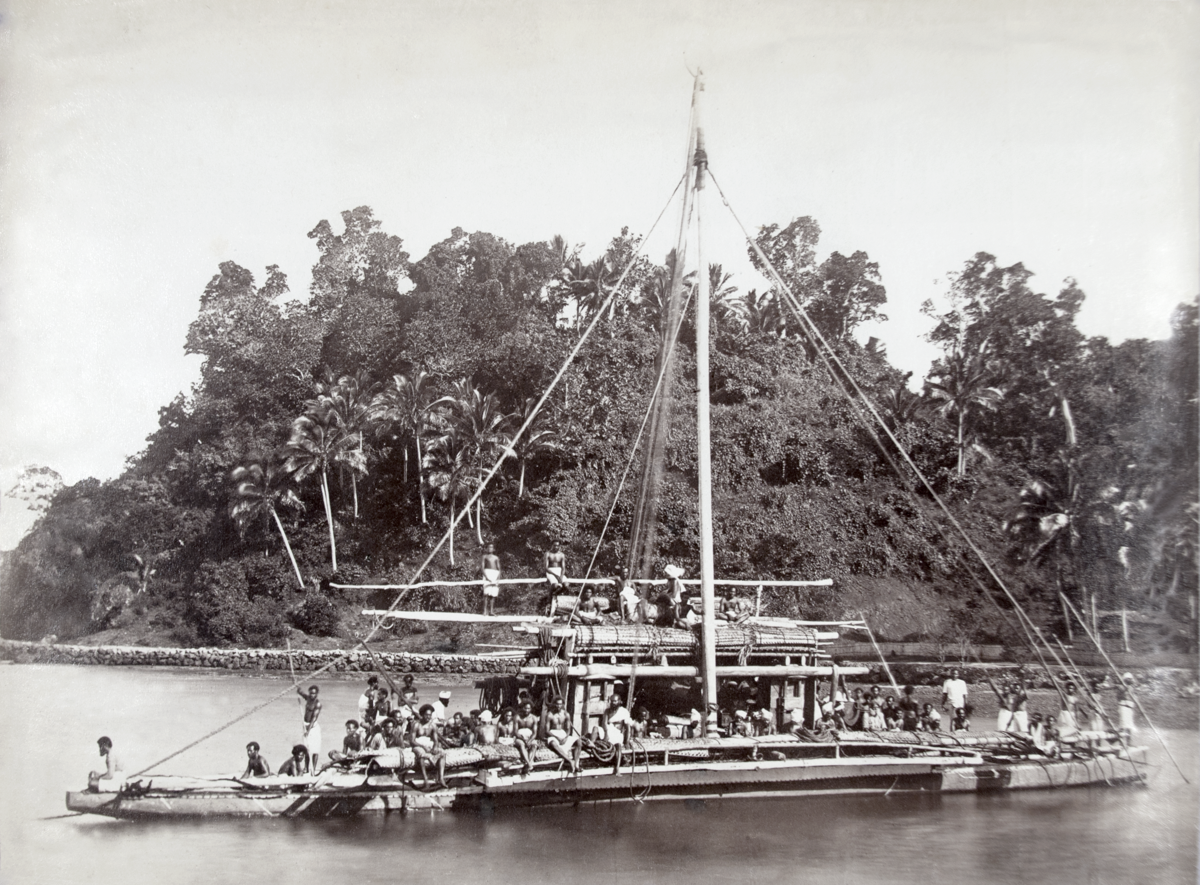
This picture was taken By F.H. Dufty of NAVUKINIVANUA - “The turner of the land” - one of the last of the great Fiji DRUA of the nineteenth century, and the last to be owned by Ratu Seru Cakobau, a Fijian Chief, monarch and warlord, anchored just off Nasova on the eastern shore of Ovalau, Fiji.

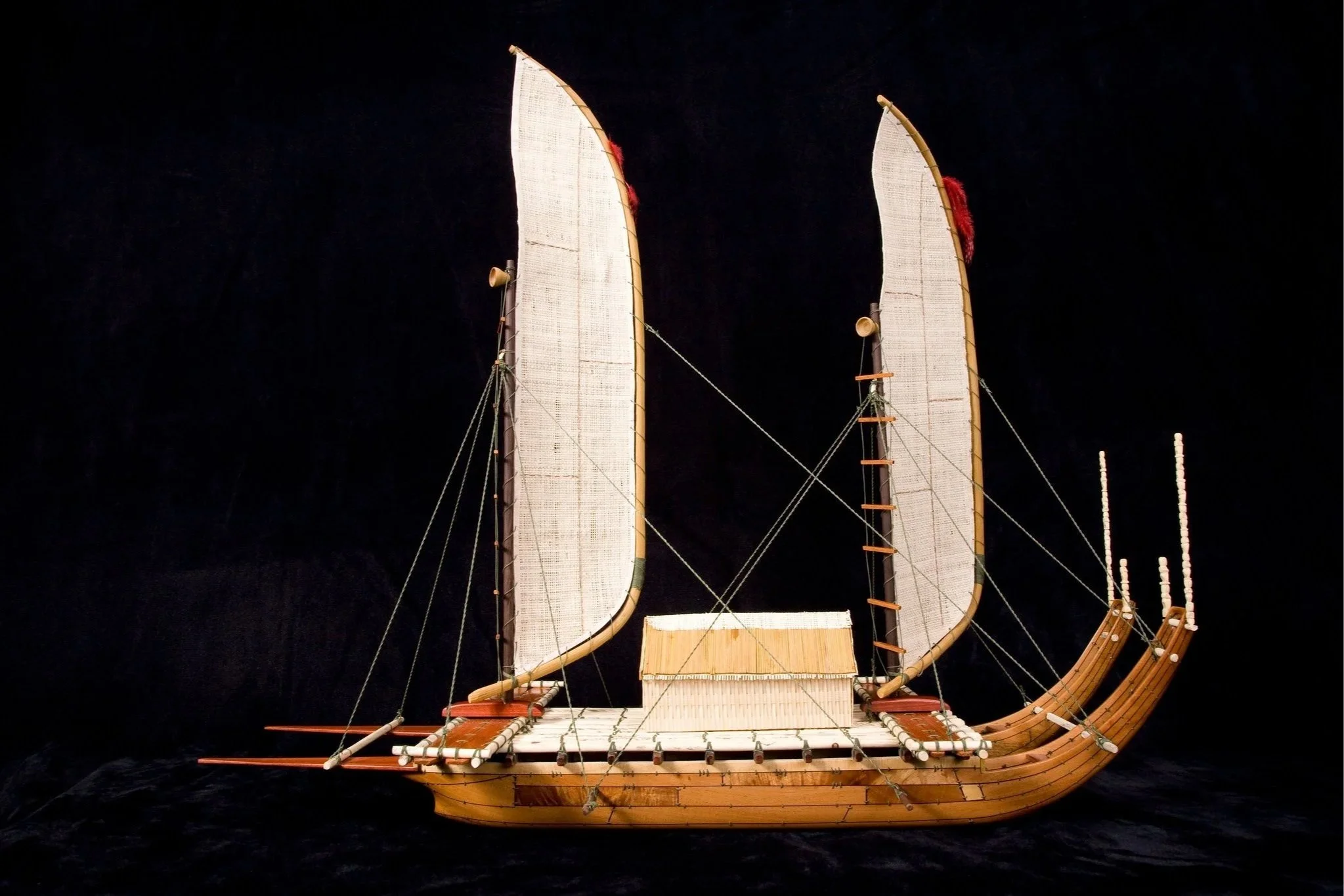
A very detailed and large model of a Fiji DRUA built by the author. The model is displayed at the POLYNESIAN CULTURAL CENTER, Lai’e, Hawaii.

HEALING THE WA'A: A New Year visit to the Puakea Foundation

On the first day of the year, while many were resting, I found myself at the He’eia State Park. There, inside the open-air canoe shed (Halau), a quiet kind of magic was happening.

I imagined the master craftsmen working on several Koa outrigger canoes. These vessels are more than just canoes; they are living lineage of wood and water. Some were in for minor “tender loving care”, while others were undergoing massive restorations.

One particular canoe caught my eye- half of the hull was being entirely reconstructed. To ensure the new koa plank followed the original lines of the canoe, the builders used wooden templates resembling bulkheads. These ribs act as a guide, keeping the hull’s iconic “U” shape true to the original shape as the new pieces of wood are placed and glued down.

I saw custom-made clamps designed to apply pressure at just the right angles, grafting new koa onto sections where the original wood had succumbed to time or rot. It’s a slow, precise process- a labor of love that ensures these “old souls” will eventually return to the sea.

For me, who has been dealing with canoes for so many years, albeit on scaled down dimensions, there’s something so moving about seeing those koa canoes in the middle of a “healing” process.

Big Mahalo to the Foundation for perpetuating this craft. It’s not just about building or repairing canoes; it’s about carrying a culture forward, it is about “mana”.

The Navigators' Legacy: Canoes of Oceania by Origin and People

Welcome to my two years of research dedicated to bridging the gap between the canoes of Oceania and their precise cultural and geographical homes. Visit my page:

A LOVE FOR CANOES, preceded by THE PROPOSAL or the vision of a few man to build an ancient Polynesian voyaging canoe, which became HOKULE’A, the most famous and most travelled of all contemporary voyaging canoes.

As a dedicated builder of model canoes, I've always admired the seminal works of scholars like A.C. HADDEN and Jean NEYRET .. Their comprehensive catalogs provide an invaluable foundation for anyone studying the history and construction of these incredible vessels. However, when seeking to understand exactly where and by whom a specific canoe type was built—down to the atoll or island—the process often requires extensive cross-referencing, especially in relation to Melanesian type canoes.

My goal with the listing of all those canoes is simple: immediate geographical and cultural context.

Connecting Craft to Culture

This resource is designed for the modern reader. Every entry provides not just the canoe’s type or name , but a direct link to its place of origin, whether it is a small, remote island or a major archipelago. When you navigate my list, you will be able to:

  1. Instantly Locate: Find the canoe's home on a map via a direct geographical link (e.g., to the island’s Wikipedia page or a reliable cultural atlas entry).

  2. Learn the People: Discover the history, language, and unique heritage of the tribe or culture that designed and built that specific craft.

  3. Appreciate the Engineering: Understand the local resources and sometimes the needs that drove the canoe’s unique construction features.

By connecting the reader immediately to the place and the people, I endeavor to transform a technical listing into a rich cultural history.

My canoe listing is organized geographically (Polynesia, Micronesia, Melanesia) and is continually updated with new information verified against historical records and contemporary ethnographic studies. As as said in the intro to my page POLYNESIAN CANOES I intend to list the canoes, which so far are listed by the broader regions of Oceania, by archipelago, atoll or island.

The Journey Continues

This project is a labor of love, developed in parallel with my primary work of crafting detailed miniature models of these very vessels. The insights gained from building these canoes—understanding the sheer scale, the materials, and the skill required—deepens the respect for the original builders.

Thank you for joining me on this journey. Please explore the A LOVE FOR CANOES and use the links, when available, to immediately anchor these incredible feats of ocean engineering within their vibrant cultural contexts. If you have corrections or additional information, please contact me, as this is a living document dedicated to accuracy and accessibility.

Note: The listings are a personal research project, based to date on two years of work by the author, a dedicated model canoe builder. Please contact the author shall he have omitted to give credit to an image or document.

MAYOTTE

I have recently been approached by a member of the University of Mayotte with the question whether I could make them a scale model of a typical "Malagasy" fishing canoe. The University of Mayotte is eagerly preparing for their Festival of Science, a significant event towards the end of the year, and they believe that a scale model of a typical 'Malagasy' fishing canoe would be a valuable addition to their exhibits.

Mayotte is a French territory situated south of the Comores Island and half way to Madagascar.

The malagasy canoes belong to the Austronesian type canoes like those from New Caledonia, Philippines, Madagascar and some from Indonesia.

A traditional Malagasy fishing canoe

CELEBRATING 30 YEARS OF BUILDING MODEL CANOES

HOW IT ALL STARTED. It was the year 1993. When moving to Hawaii from the UK, Francis Pimmel was surprised to notice that, with one or two exceptions, nobody was building scaled-down Polynesian canoes, the very symbols of Polynesian culture and seamanship. Francis's love for boats and ships, particularly catamarans and trimarans, dates back to his time in the French Forces near Brittany, where famous sailors like Eric Tabarly set sail to win many races. Being passionate about boats, Francis Pimmel was fascinated by the exploits of Hokule'a, a voyaging canoe built in 1974, which sailed to Tahiti and back in 1976 solely guided by the sun, stars, waves, and wind. And then, in September 1992, Francis was given a chance to go onboard Hokule'a, which was moored in Honolulu on Pier 38 then. By chance, Wright Bowman Jr., who established "The Friends of Hokule'a and Hawai'iloa, was on the deck of Hokule'a; he graciously accepted Francis's request to come on board, take pictures, and make measurements to make a model of the canoe.

Present that day was also Ben Finney, a renowned anthropologist known for his expertise in Polynesian navigation and canoe sailing and a founder of the POLYNESIAN VOYAGING SOCIETY. Having the opportunity to meet and interact with these influential individuals solidified Francis's determination to contribute to preserving and celebrating Polynesian culture.

Inspired by the rich history and significance of the Hokule'a, Francis embarked on a personal endeavor to construct scaled-down replicas of Polynesian canoes. Francis's passion for accuracy and authenticity drove him to study the many canoe types across Oceania and their construction methods, materials, and designs to ensure the utmost fidelity in his creations.

Through tedious craftsmanship and unwavering dedication, Francis painstakingly constructed these scaled-down models starting in 1993, seeking to capture every intricate detail that made Hokule'a and other Polynesian canoes such marvels of maritime engineering. From the elegant curves of the hull to the intricate lashings and rigging systems, each model was a testament to Francis's commitment to reviving the art of traditional Polynesian canoebuilding.

Word of Francis's remarkable craftsmanship soon spread, and enthusiasts, collectors, art galleries, and famous interior designers marveled at the exquisite replicas he had and still creates. His scaled-down canoes became cherished pieces of art, bridging the gap between past and present and serving as symbolic reminders of the extraordinary achievements of Polynesian navigators.

HOKULE’A in the lobby of the FOUR SEASONS HOTEL RESORT, MALAMA BAY, LANAI, HAWAII

Home and Garden TV (HGTV) featured Francis Pimmel and his work on their nationwide show "MODERN MASTERS" on November 4, 2001. Details on HGTV.com


PRICING

PRICING.When it comes to creating a model, such as a model canoe, the key factor that affects its cost is its size. This is because the size of the model determines the level of detailing required, which is a labor-intensive process. So, if your 12-inch model costs $200.00, you cannot simply use three as a multiplier for your 36-inch model, since it is much more detailed and requires more work.

MO'OLELE CANOE
I have been said that Mo’olele perished in the Maui wildfire and that all what is left is the scale model of it that I built some time ago and which belongs now to Rob S. who used to sail on it.

MO’OLELE Thanks Rob for that incredible shot.

MO'OLELE CANOE
I was recently commissioned to build a scale model of the MO’OLELE. I have never seen this canoe in real nor did I have a lot of material to work on it. Actually I found a total of 3 videos about Mo’olele of which one was instructive regarding the rigging of the sail while the other gave me finally an answer as to how many seats were installed within each hull and the shape of the spreaders. Beside all this I had to calculate the dimension of the hull, the beam of the canoe and draw lines, What surprised me most while doing the drawings is that contrary not only to how Hawaiian sailing or voyaging canoes were supposedly built but also to hydrodynamic laws, the deck at the front of the vessel was parallel to its draft while the deck at the stern was raised. It did not make sense to me from a maritime architectural point of view at all and I would love to hear from anybody involved in the construction of Mo’olele why the deck was raised at the stern and not at the bow of the vessel.

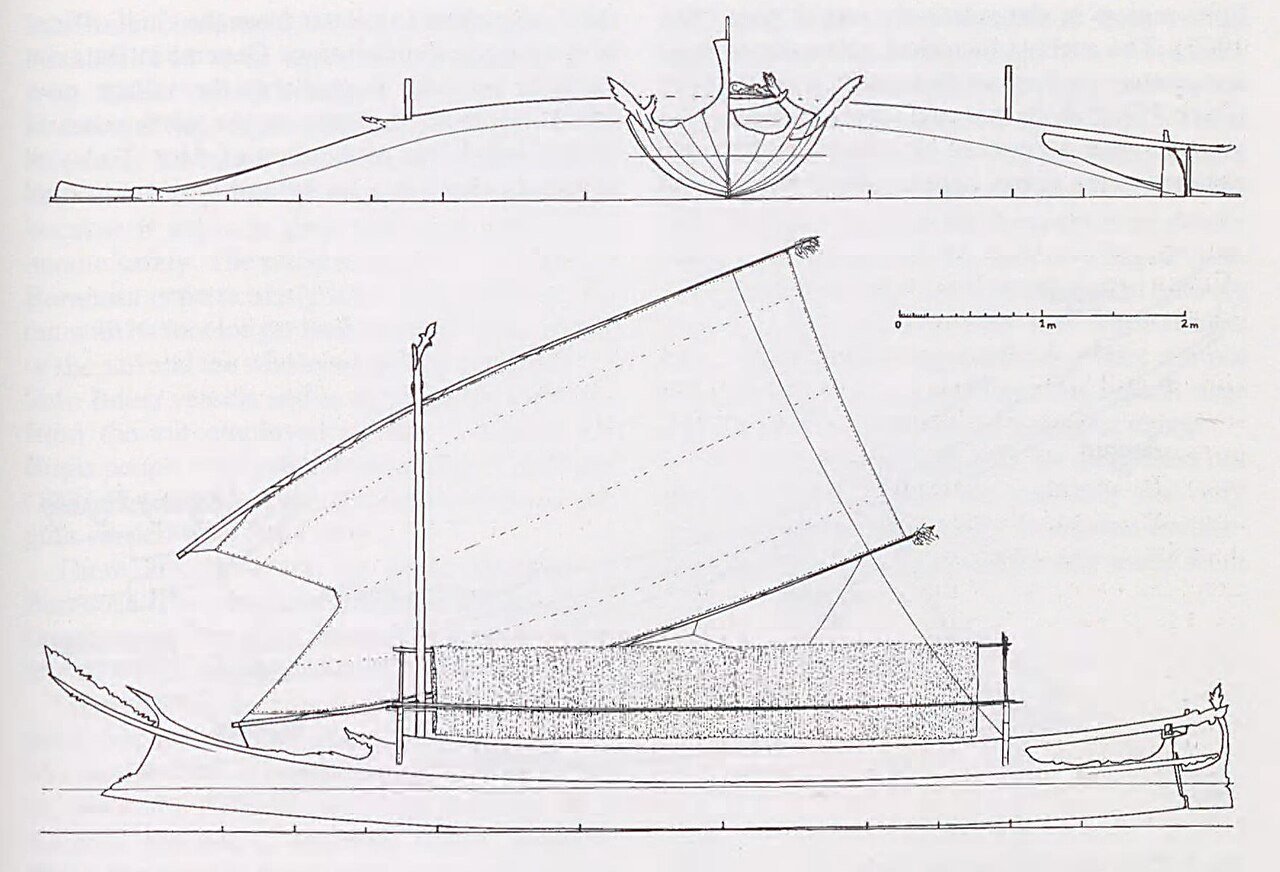
Line drawing of the Mo'olele

Line drawing of the Mo’olele

About CANOES OF OCEANIA by Haddon & Hornell

There is no doubt that “Canoes of Oceania” by A.C. Haddon and James Hornell, Volume I, II and III is the authoritative source on canoes having sailed across all islands of the Pacific Ocean , from Hawaii down to New-Zealand and from the Philippines to Easter Island.  The various canoes from Polynesia, Micronesia and Melanesia are described in minute details sometimes difficult to understand or visualize.

I really love to go into “Canoes of Oceania” in order to get an overall picture of the vessel in question.

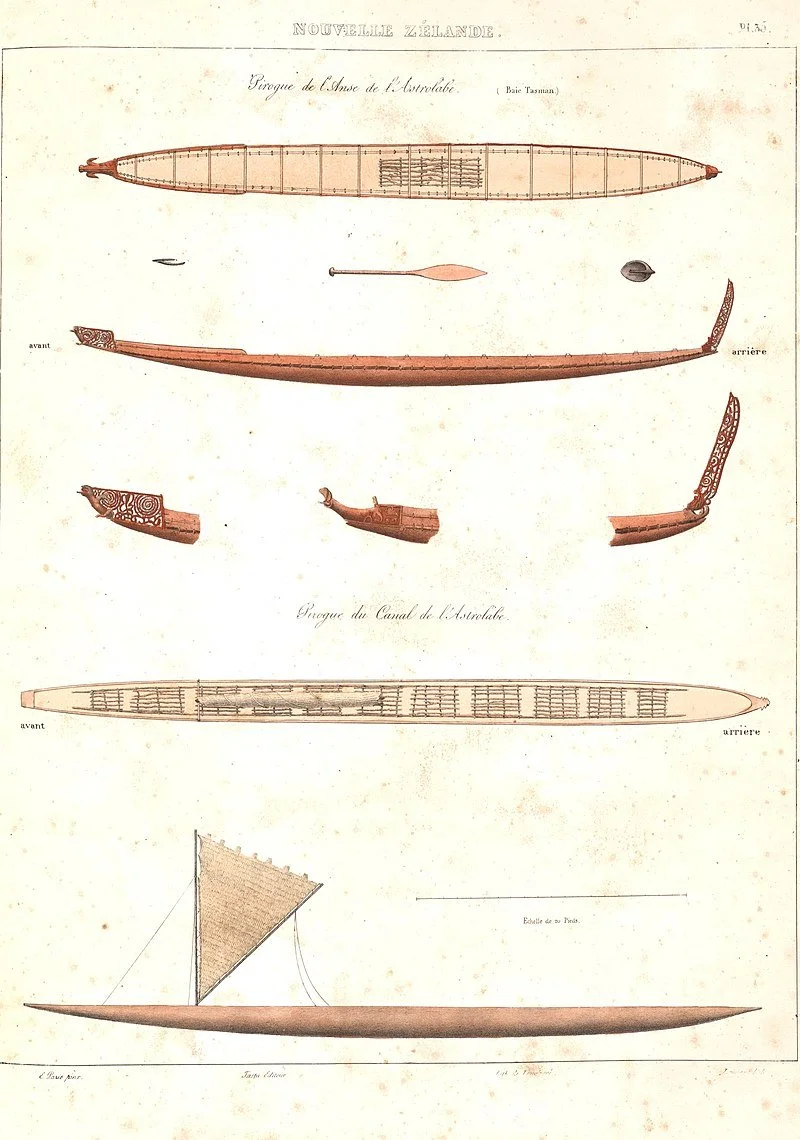
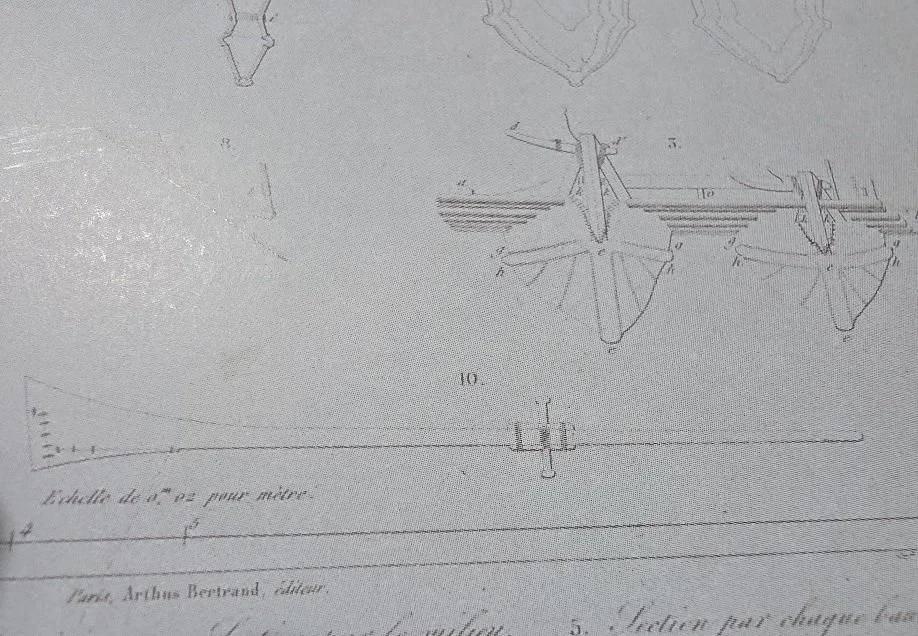
But once I decide which canoe to replicate in a scale down version, the 2 volumes written by Jean Neyret in 1976  entitled PIROGUES OCEANIENNES provide a trove of extremely easy to understand descriptions and drawings about the hundreds of different type of canoes ever built across Oceania.

Whereby the writing by Haddon & Hornell is very academic, at least this is how I feel it to be,  the one by Jean Neyret is easy to read and nearly every construction detail is illustrated with  numerous drawings.

But it just occurred to me that not everybody is fluent in French because obviously PIROGUES OCEANIENNES is written in French and was never translated into English.  Say no more !

The 2 volumes by Jean Neyret are illustrated in the books section.

About Austronesian canoes

For the last few days I was reading the work “WANGKA The Austronesian Canoe Origins” written by Edwin Doran, Jr., with a foreword by Ben R, Finney.  While going over the pages I came across a line drawing of a typical Sulu Archipelago double outrigger.  The Sulu Archipelago is a chain of islands in the Southwestern Philippines that forms the northern limit of the Celebes Sea and which is predominantly Muslim.

For most Filipino a canoe, regardless of its type, is just a “banca”. But the Sulu double outriggers are of the type vinta nardi rigged with spritsails of exceptional beauty.  Further study of this particular type of vessel led me to discover, online, copies of 18th Century drawings of more than 280 different type of canoes, whether single or double outriggers, dugouts or double canoes distributed all along the South East Asia, from Taiwan to Malaysia, Vietnam, Thailand, East Timor, the Philippines, Borneo, Indonesia, Brunei, Java, Bali, Singapore, Orchid Island. That multitude of canoes and the familiar sight of their outriggers and floats, not mentioning common words used by the Tao of Orchid Island and Maori in New Zealand,  cannot but live you with the undeniable impression that the Polynesian, Micronesian and Melanesian have all their origin in South East Asia.

Sulu Canoe

Sulu Canoe

Over the last 20 years I did build up a large collection of books, archival papers and photos about Oceanic and Austronesian canoes but little did I expect to be able to add another 280 drawings . I cannot wait to replicate some of them, in particular the Sulu type canoe.