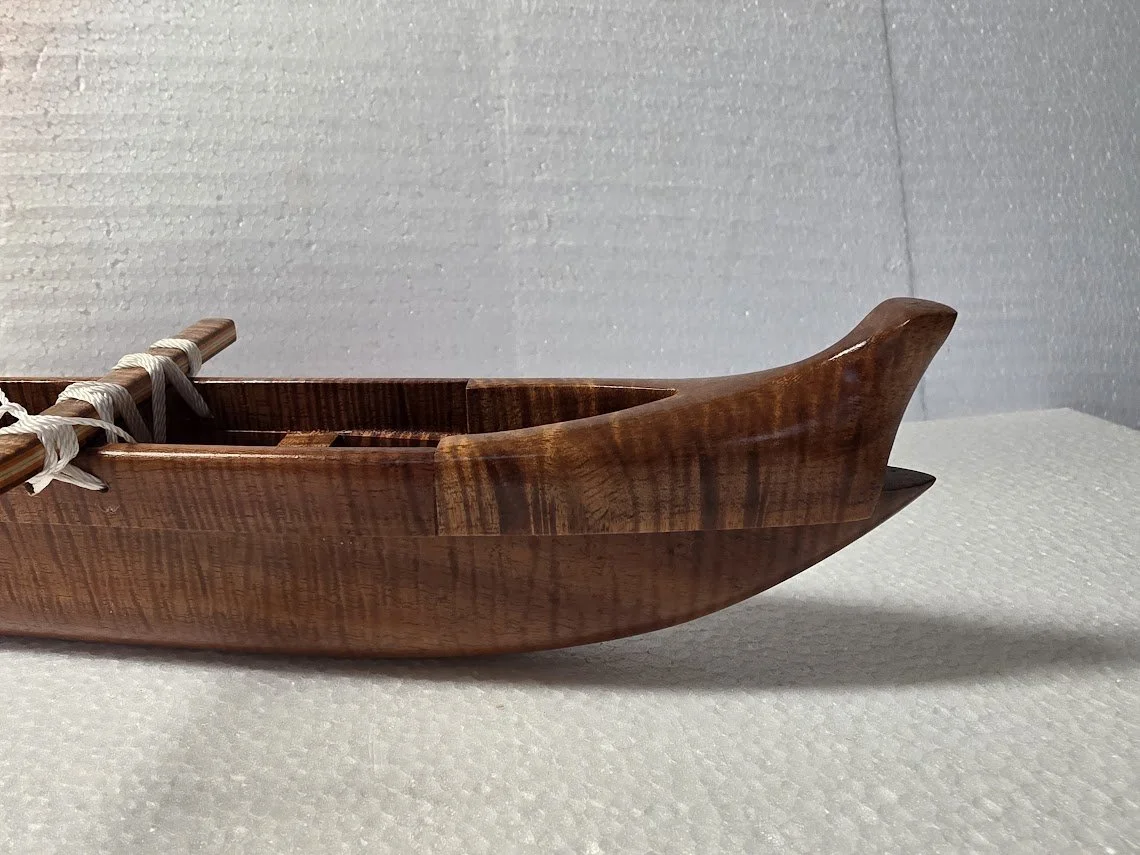
"The stern cover (i ka manu hope) ended a couple of inches short of the very tip of the after end of the canoe, always leaving a projection called the moamoa. The moamoa is still a design feature of canoes made today and serves to secure ocean racing covers”.The Hawaiian Canoe by Tommy Holmes.
I have read several distinct other concepts and the usage of this projection:
It is traditionally believed to be the sacred spot where the spirit (akua) sits to watch over the crew (paddlers)
It symbolizes courage, collaboration, guidance, and strength of will.
Its cultural origin stems from the historical voyage of the high priest Pa'ao from Kahiki (foreign land) to Hawaii.
"During the initial carving of a canoe log, a maku'u was left on both the bow and stern ends of the hull. Those knobs served as sturdy, structural attachment points for heavy hauling ropes used to drag the log to the ocean." He Makee Waa
"Once the canoe construction was finished, the bow knob was removed, but the stern knob was usually refined and carved into a pointed protrusion known as the moamoa" He Makee Waa
I always thought there must be a practical reason for the moamoa's presence.
Imagine for a moment sitting in your outrigger canoe, fishing along the shores of the islands, paddling among rock outcrops near the shore at Waimea. Sometimes you have to maneuver backward and maybe hit some rocks.
You will be hitting it with the moamoa, which is slightly farther out than the tip of the manu, thereby avoiding damage to the manu hope. Was the maomao intended as a shock absorber?