The craft of building miniature vessels is often met with a common misconception: that scale models are merely toys or simple shelf decorations. Even among those with salt water in their veins, there is sometimes a tendency to overlook the profound technical history and skill required to shrink a vessel down to size.
For centuries, the scale model was a fundamental stage of maritime engineering. Long before the first plank was laid or a single nail was driven into a hull, shipwrights and master builders constructed "block models" or "builder’s models." These were not for play; they were the primary blueprints. They allowed the builder to study the displacement, the curvature of the hull, and the harmony of the design in a three-wide environment.
In the modern era, this phase has largely migrated to the digital realm. Engineers now use complex 3D software to render every bolt of a car, every rivet of a plane, and every frame of a ship. While these digital twins are efficient, they lack the tactile reality that a physical model provides.
The process of building a miniature by hand—especially one scaled precisely—is a feat of both research and endurance. To do it correctly, the creator cannot simply guess. They must become an amateur historian and a structural engineer, familiarizing themselves with every component of the original craft, from the specific joinery of a Fijian Drua or the intricate lashings on the contemporary Hokule’a to the exact taper of a traditional paddle.
Achieving a high-quality result is a rare combination of technical skill and extreme patience. It is an exercise in "thinking in three dimensions" while working with materials that do not always want to be tamed at such a small scale. Far from being toys, these models are a tribute to maritime heritage and a testament to the meticulous research required to keep that history alive.
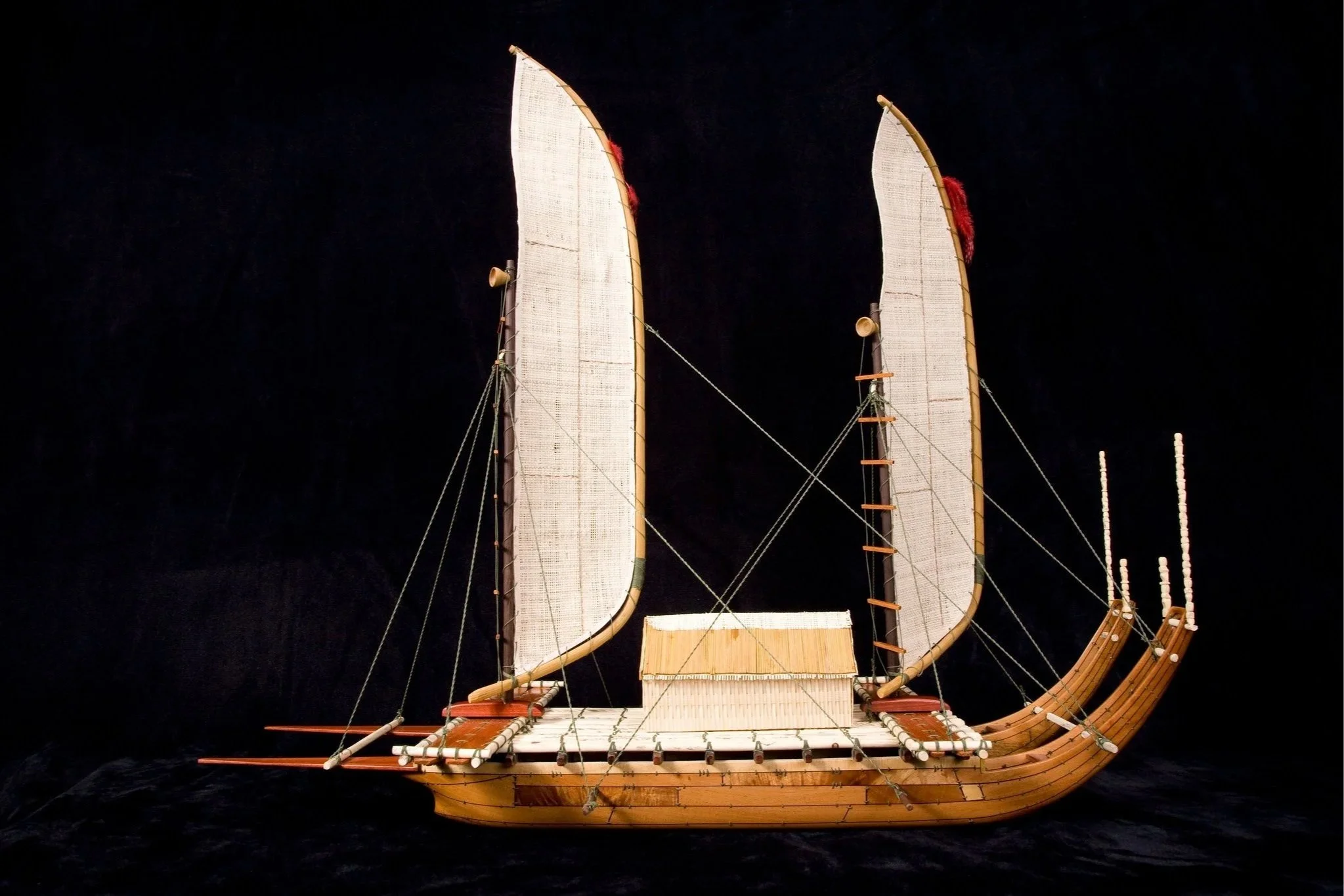
Large Tipairua canoe model built by the author.