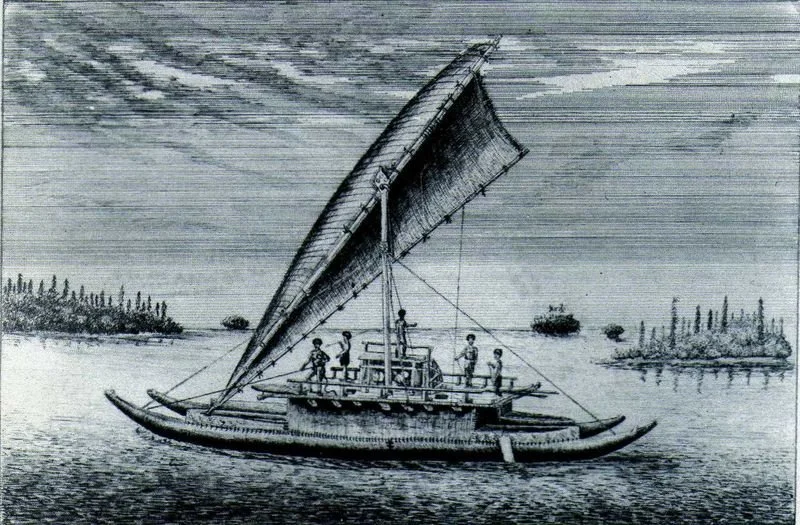
The "ALIA" introduced in Samoa during the 19th century is a Tongan adaptation of the double-hulled canoes from Tonga of the type "KALIA", which in turn have been copied from the Fiji DRUA.
All three types of canoes consist of two hulls of equal length for the "Alia" and "Kalia", but a larger main hull and a smaller outrigger-style hull for the Fiji DRUA, connected by a deck onto which the builders installed a hut covered with great pandanus leaves. The rigging consisted of a lateen sail.
Before the ALIA, there was apparently a predecessor in the name of VA’A TELE of whom we know little except that when changing tack had to be put about the same general way as European sailing vessels, whereby the ALIA, the KALIA, and the DRUA were able to sail forward from either end.
As previously mentioned, the ALIA was a replication of every aspect of the Tongan KALIA and was therefore commonly called KALIA as well. However, the Samoan improved it by introducing the hidden lashing gunwales to the hull. This technique spread to Tonga, where it was used on the TONGIAKI, and to Fiji, where the canoe builders used it in the DRUA. Another interesting detail introduced by the Samoans was the vertical bow at the forward end of the hull, but pointed toward the stern.
It is also worth mentioning at this stage that the Samoans introduced the very concave profile, or clipper bow, at the forward end of their outriggers.
What can be said to the credit of the Samoans is that, from the outset, they were able to build "ALIASES" with a high level of detail and perfection.
The huge canoe that they wanted to offer to Kaiser Wilhelm II, but which could not be transported to Germany because of its large size, was comparative to the most beautiful realizations in Fiji and Tonga, like finstance the RAMARAMA, long by about 100 feet or 30 meters, and transport over 100 people.
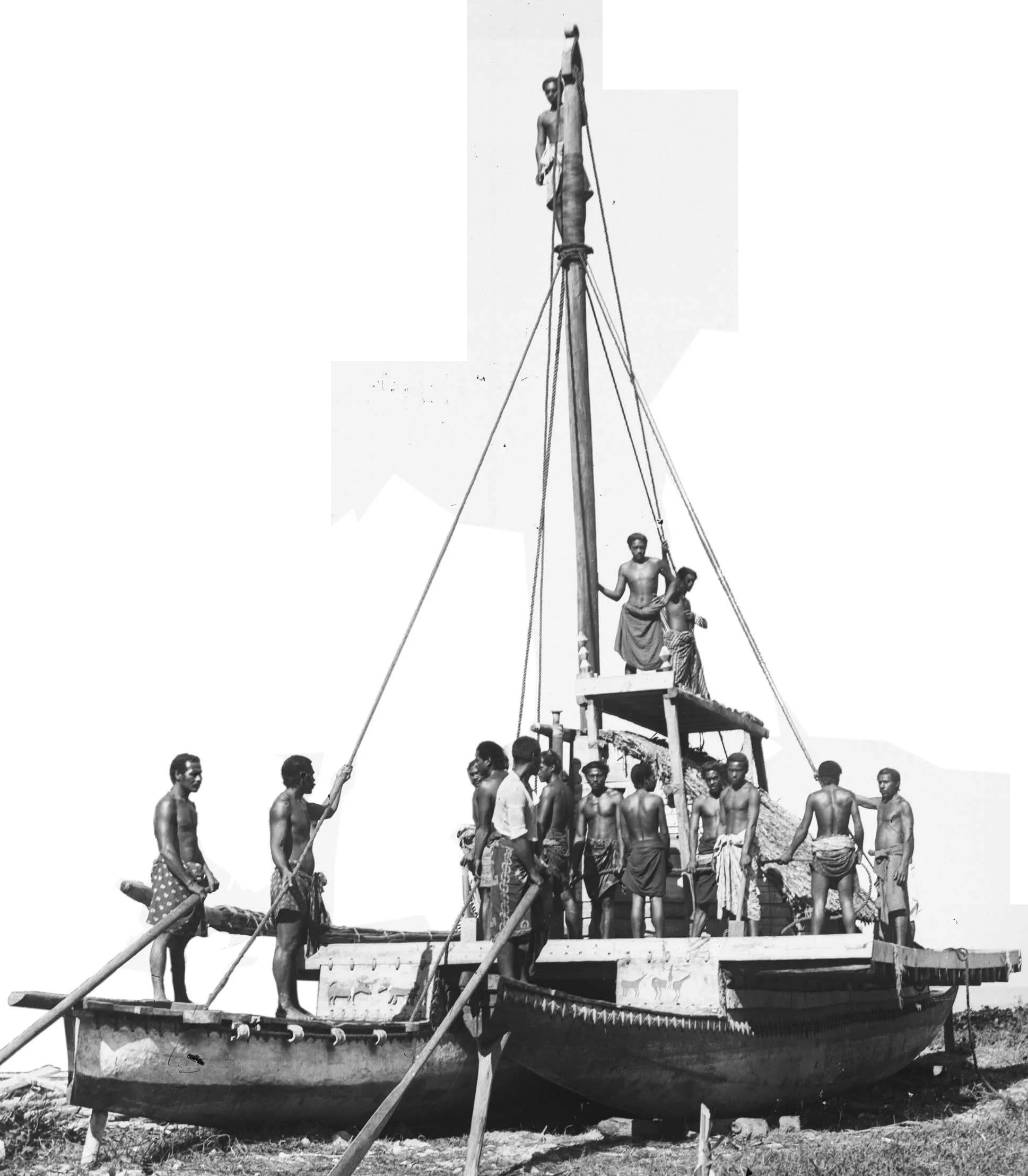
A Samoan double-hull voyaging canoe of the type ALIA
The KALIA from Tonga were more advanced, faster, and larger double-hulled vessels, replacing the older, slower TONGIAKI canoe. In use until the second half of the 19th century, when they disappeared, the KALIA’S were precisely similar, in every aspect, to the Fiji DRUA. Actually, the Tongan carpenters built a good number of them in Fiji on the islands of Kambara and Vulanga.
There is also the story of the famous and legendary vessel, the LOMIPEAU, a massive 16th-century Tongan double-hulled canoe, a KALIA, built in Uvea (Wallis Island), which transported heavy lime and basalt stones to the Tu'i Tonga from a faraway island believed to be Wallis.
The Tongans were audacious long-distance navigators, with incursions as far as the Solomon Islands and New Caledonia, in particular the Isle of Pines.
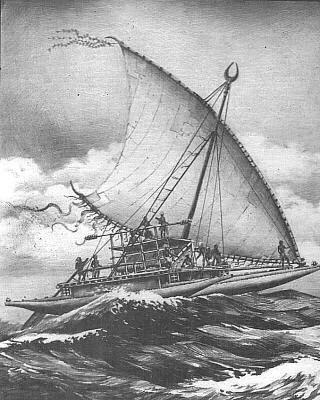
Tongan KALIA
The double-hulled canoes from Fiji, the DRUA, are considered, rightly so, as the masterpiece of Oceanic canoe building. They combined to the highest degree the most enviable nautical qualities: extraordinary speed (15 to 18 knots), cargo capacity, the RAMARAMA, which was long by about 100 feet and could carry 500 men, and very good seakeeping.
The primary advantage of the double canoe is its wide wheelbase, which gives it considerable stability while presenting minimal resistance to forward motion, as the two canoes (hulls) are very narrow: a wide beam of 4 feet for a length of 100 feet, giving a ratio of 1 to 25 between the width and the length whereas in sailing vessels the proportion is generally 1 to 3.
On the other hand, the wheelbase's width allowed the use of a sail that seems truly excessive. The yards of the RA MARAMA were over 110 feet long, the maximum width of the sail reached 78 feet, giving a surface area of over 4000 square feet.
The ALIA, KALIA and Fijian DRUA are arguably the apex of South Pacific canoe-building design and performance, some over 100 feet long and capable of speeds around 15 knots. The question is: what kind of material allowed the construction of such large-hulled vessels? It was the availability of the Vesi loa (Intsia Bijuga) tree, especially in the Southern Lau Group. A spreading tree reaching heights of up to 130 ft. The presence of such trees attracted master craftsmen from Samoa, Tonga, Fiji, and as far as New-Caledonia resulting in cross-cultural exchange to produce the finest voyaging canoes of their time.
It is therefore no surprise that a new type of double-hulled canoe was introduced to Pine Island (New-Caledonia) by visitors from Tongatapu or Haapai, who were hardy navigators. This type of canoe is an integral copy of the Fijian DRUA adopted by the Tongan. One interesting particularity is the shape of the hull's extremities, which end up pointed or slightly rectangular. The cover at both ends of the main hull (tau) was of a more simplified construction than the intricate pieces on the DRUA.
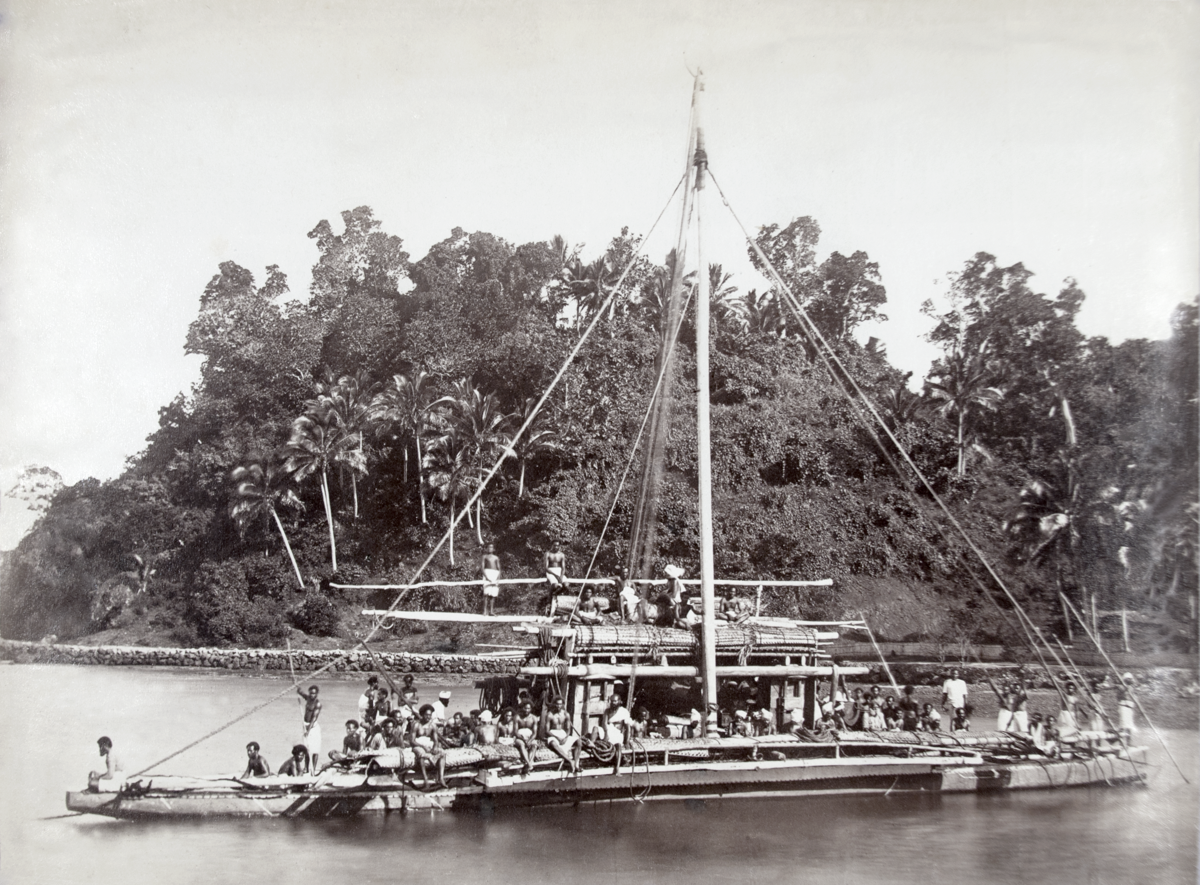
This picture was taken By F.H. Dufty of NAVUKINIVANUA - “The turner of the land” - one of the last of the great Fiji DRUA of the nineteenth century, and the last to be owned by Ratu Seru Cakobau, a Fijian Chief, monarch and warlord, anchored just off Nasova on the eastern shore of Ovalau, Fiji.
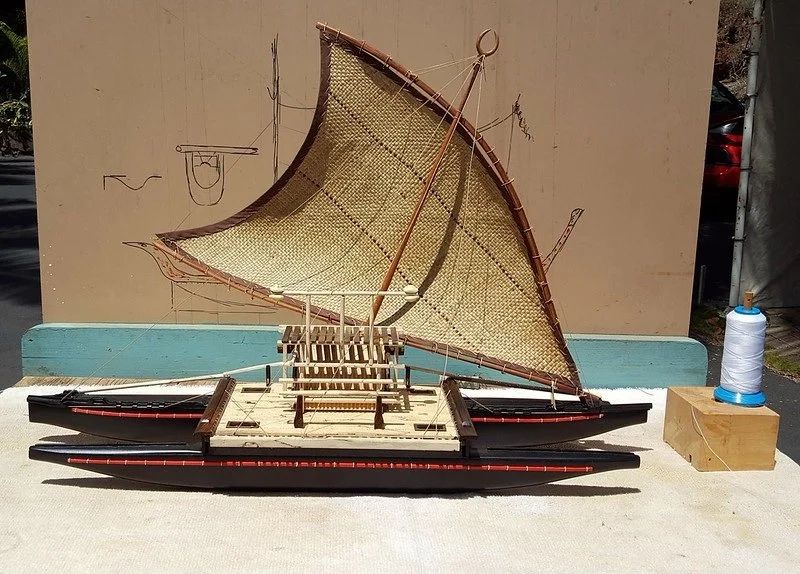
A very detailed and large model of a Fiji DRUA built by the author. The model is displayed at the POLYNESIAN CULTURAL CENTER, Lai’e, Hawaii.