Back on the “block”

Was it writers block or busy doing other things? I believe it’s a bit of both. Anyway I am back on the block after a sabbatical lasting a few months. I really like this word “sabbatical” as it translates with “Forshungsurlaub” in German, which really means a vacation of studies and research! Well, this is exactly what I have been up to ever since bailing out the water from my flooded workshop.

Never short of work been commissioned to build model canoes of Oceania, I also spent much time and effort building up my photo albums on Flickr and Picasa. Most recent photos do illustrate 2 very beautiful surfing canoes and a Samoan one man fishing canoe been auctioned at Niketown in Waikiki.

The Hawaiian canoes were quite old, carved out of Koa tree logs.

Need a workout?

If living in Hawaii is a dream for many, dealing with flash floods and landslides is not what most people think about our islands.

It all happened very fast, just a few days ago on December 11th at 5.30 AM.

The heavens opened up to torrential rain causing extensive flash flooding and a landslide just on top of my property.  Within minutes a river of mud, rocks and other detritus run into my sloppy backyard and towards my front gate. I did not realize that the mud and branches will get stuck at the gate and therefore stop the proper flow of the mud and water. The water level rose so fast that in no time it runs into my workshop, flooding machinery, lumber, templates etc.

Towards 10.00 PM the rain stopped and it is only than that the extend of the damage caused by the flash flood became apparent to me. My yard was filled with 2 feet of mud.

My pick-up truck was stuck in the mud, so was another car, my drive-way was busted and the roots of a gigantic Albizia tree were laid bare.

First thing first, I immediately started to pump out the one foot of water that had flooded my workshop and installed fans and heaters to dry some motors . But clearing the mud and rocks will take days. I guess that at the rate of 2 hours a day this will be a good and cost free workout. Want to join ?

Flooded table saw, planer etc.

Flooded table saw, planer etc.

Sail away

What happen with my 28″ Hawaiian double hull voyaging canoe you may ask ? 

Well I had to make a new sail and finished the rigging by August.. A few days later the canoe was sold and sailing, or rather shipped, to a collector on the mainland. And here I am again, thinking about a more efficient, more hydrodynamic racing canoe..

Days 3 to 12

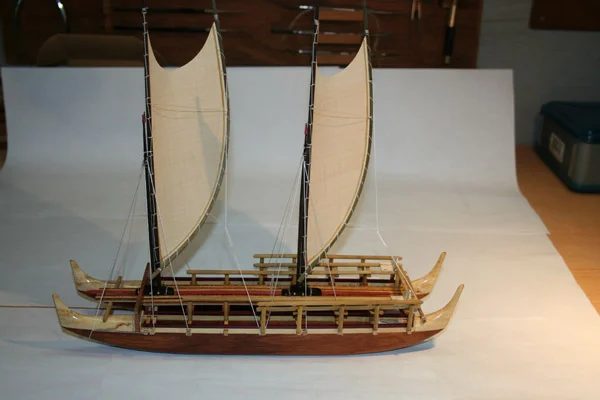
Ten days have gone by since writing my last post. The building of the 28 inch double hull canoe I had designed a few days ago was finished yesterday August 2nd with the rigging being the remaining task to be done.


I was near to mount the sail today would it not have been for a moment of inattention.
 

Indeed I had spend several hours crafting the sail when, within a fraction of a second everything went to waste. In wanting to clean the sail I somehow lifted one corner of it to fast and it broke. That was the end of that. I will have to make a new sail tomorrow.
 

Otherwise I am very satisfied with the canoe. I used highly figured Koa for the bow and stern tops as well as for the stacked up rims.

Day 3

The entire day I was occupied in finishing a Solomon Island war canoe, the famous “Tomako” used to go hunting for ‘heads”. But this model has been commissioned to serve as a gift to be offered to a famous author about Pacific history and culture. I am posting here a picture of the prow ornaments of the canoe but further details can be seen in my Hawaiiancanoes Flickr album. I have a special liking for the Solomon Islands canoes.

Indeed I find them to be some of the most gracious canoes ever built in the South Pacific. Ingeniously plank built, rather than carved, the prow and stern of those war canoes are exceptionally tall and beautifully decorated with shells and feathers, as well as with the famous nguzu-nguzu figure. Another type of canoe very similar to the Tomako, and plank built as well, is the Filipino banca (boat) from Lake Taal.


If their hull shape and impressive prow and stern looks very much alike the Tomaka, they differ however in that the Tomako has no beams and floats whereby the Filipino banca is invariably equipped with a set of 2 double outriggers, sometimes 3 for the larger bancas. And again, there is a further type of canoe whose hull shape and construction is remarkably similar to the two previous ones, and this is the Perahu katir from Java.

After spending most of the day on the Tomako model, I hurried to draw the lines for the 2 hulls of the voyaging canoe as viewed from top. Without that set of line drawings I would not be able to calculate the height of the beams nor have a proper idea regarding the shape and width of the beams.

My double hull sailing canoe

Its one of those days again when I get impatient to make something different, and it does not really matter whether it is a Hawaiian or any other type of canoe or ship, but simply one that is not alike the canoe models I made in the last few months and which invites to be imaginative and creative to build it.
 

This process mostly starts in the middle of the night. I wake up and pictures start forming in my mind. I see the lines of the boat or canoe, I can visualize its beauty. I go through the mental process of building or carving the model, piece by piece, step by step but fully aware that things are easier done in one’s imagination than in reality. And it’s with this in mind that I try to foresee the difficulties in wanting to build this or that model and figure out solutions to resolve them.
 

The entire visualization process will stay fresh in my mind for days and I put some of those mental pictures onto paper today by drawing the lines of that Hawaiian sailing canoe that kept me awake for a couple of hours in the middle of last night.

Hawaiian Canoes on Flickr

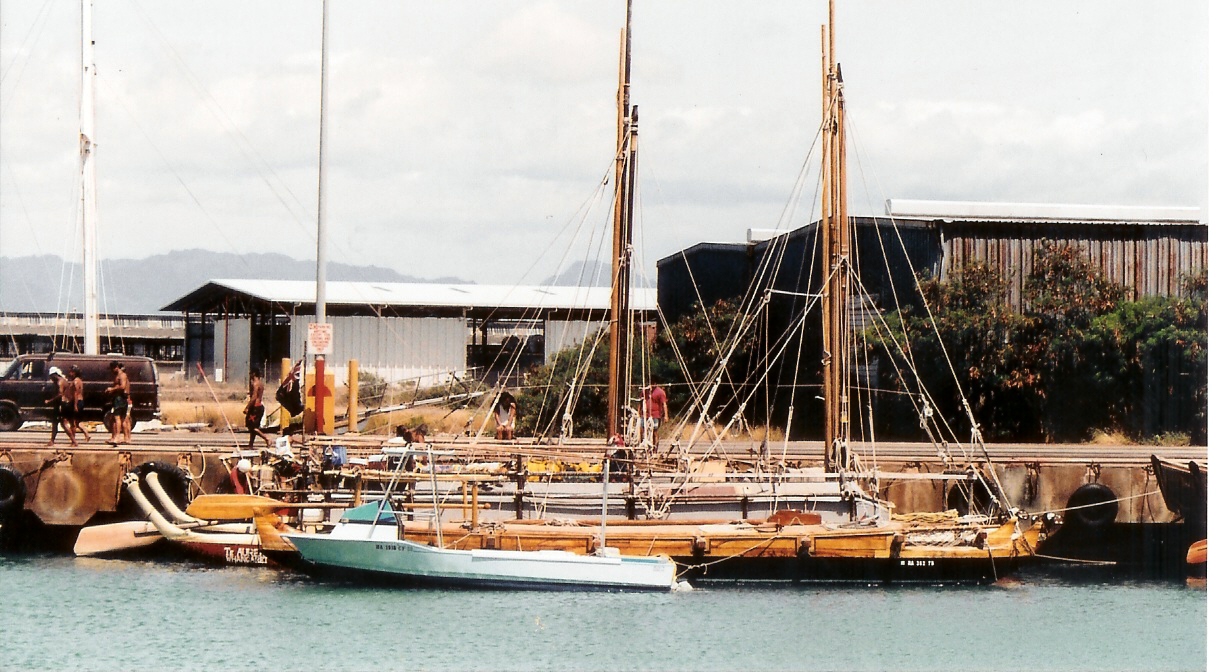
I will never forget this very sunny day of May 13th 1995, en route from Mililani to Honolulu to visit the various Pacific Rim canoes that were meeting on Oahu and mooring on Pier 36, also called The Keehi canoe lagoon.
 

It was an exciting day as I was very conscious that such a gathering of various type voyaging canoes in one single place may not happen that soon again, maybe for the duration of an entire generation.
 

I felt that there was a unique occasion to take photos of all those canoes, in particular to take pictures of the construction, lashing and rigging of each one of them so that when the time comes that a next generation or group of people wants to build the same type of canoes, they will not again have to figure out how those vessels were built and assembled. Indeed, some of those proud canoes will end up bowing their prow on a sandy beach and slowly go to waste in the burning sun of the Pacific. All that will be left is some photographic documentation of their construction and ensuing epic voyages across and beyond the Polynesian Triangle.


I remember meeting Ben Finney at the Pier, in my eyes the real hero of that fascinating story called “HOKULE’A”. Ben Finney’s book “Hokule’a, the way to Tahiti” was the inspiration for my very first scale model of the double hulled voyaging canoe. Ben explained to me the origin and signification of the prow ornaments on the Te’Aurere canoe while I was taking pictures of it. Crew members of the Hawai’iloa invited me on deck and let me take pictures and measurements, while others, on the Makali’I took down the mast.

I shot 6 rolls of film negatives that day and when I came home placed them all into a box with the intention to have it developed within a few days. Days became months and month’s years. Some 13 years later I finally had those negatives developed and their photos are now on Flickr for everybody to see and study.

Writer's block

A famous author said that having a writer’s block is either when one is thinking to much of himself or when having nothing to say about oneself!

My reason for not writing here, lately, had more to do with what was happening on the political front of our country. You see, having to make a living during day time, I could not wait to sit in front of the TV at the end of each day to listen to what all those political pundits and so called experts had to say about some politicians and other political pundits and experts. Actually I have to admit I let myself be indoctrinated, brain washed, lied to, made to hope, to curse, clap my hands, stand up and cheer, and so, no wonder I very quickly ended up with a total writer’s block, feels like a kind of a hangover by the way, unable to even write a check to cover the gas bill...

The party is half way over…and the big mesmerizing speeches are already part of history. Its time to resume my work and write my own humble little stories.

Day four and sail away..

Of course I always feel great satisfaction once I put the last touch on a model, but I am also very critical of my work. Maybe not noticeable to the layman, but I am unhappy with the width of the masts. They are not exactly to scale. Also, some of the rigging is not sufficiently stretched. To much pull on one side and it will hang loose on the other side, so I start to tighten the loose cordage only to loosen up the opposite rigging. The rigging is a real pain on such a small model and it takes hours and a ton of patience to do it. I sometimes wonder how I can do this nitty gritty stuff with my “carpenter” type hands.

Tomorrow the model will be crated, together with its base and showcase, and shipped to Maui.

Day 3

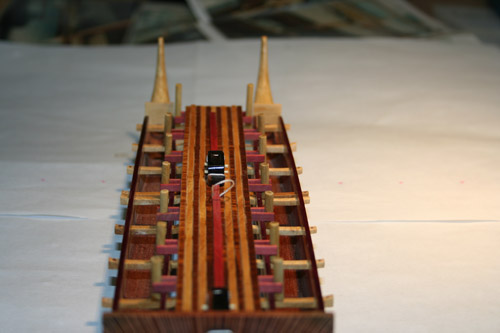
After my third day of working on this model, the deck and the mast steps were placed and I started to mount the railings. When ever it may enhance the beauty of a model, I like to use different type of exotic and indigenous color coordinated species of wood to build my canoes. So for example on this small Hokulea the deck is made out of curly Koa and curly Primavera, Noni for the railings and Macadamia for the big water guard, Tamarind for the manus.

Bart's saw mill

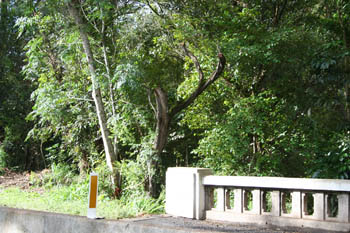
Once upon a time there was a beautiful, although unkept , nursery right behind the white fence you see in the enclosed picture. Actually there was no fence those days, alongside H2 freeway, only those Koa Formosa trees. Various species of palm trees and some indigenous plants used to grow in this nursery. Wild boars loved to roam and forage in it, not for palm tree roots or seeds, but for the many passion fruits that grew around the vinery. Behind the houses that are there now used to be Bart P. sawmill and I vividly remember the many logs of Eucalyptus Robusta Bart used to store and mill at this place. The sawmill has gone and so the passion fruits. The boars made space for the people to move in but they are not gone, I can still spot them, sometimes 6 to 8 at a time, foraging for fallen mango fruits.

Connecting the hulls

Day 2 of making the small 12″ Hokulea model. Certainly the most tricky and time consuming step in building this small model is connecting the 2 carved hulls with their wimsy small beams at their precise intervalles. Honestly I hate to do it. One would need kids hands, everything is so small and pieces tend to fly away at the slightest interference. But once all this is done, its time to place the gunnels and the hull to hull spreaders. After that its plain sailing so to speak although I still need to assemble or place more than 100 little components to call it Hokulea, and each little individual component needs to be cut, shaped, sanded and lacquered before it can be place on the model.

Hokulea

Its a long time I have not done a 12 inch scale model of the Hokulea and I feel a bit anxious to get on with it. But like always when dealing with a new model or one that I have not done for a while, I need to dig out plans or have new ones made, dig out templates, scale down sizes, check the lines, select the woods I will be using etc, basically spend an entire day getting stuff together and than finally, the following day, a small model of the Hokulea is in the making starting with 2 small pieces of Koa.

The last stand

The Kiawe tree.

Kiawe trees are descended from a single tree planted in 1828 at a corner of a church in Honolulu. By 1840, thanks to the seeds collected from that first tree, progeny of the tree had become the principal shade trees of Honolulu and were already spreading to dry, leeward plains of all islands.
In Hawaii, Kiawe is most common on leeward costal areas but it some locations, however, it can be found at 900 feet elevation.

Kiawe, for most Hawaiian, is synonymous with barbecue chicken, ono grilled food, as it is mostly used as fuel. Its wood is dark brown, extremely dense, with a beautiful polish. 

If there are many Kiawe trees along the leeward side of Oahu, there is only one, to my knowledge, along Kamehameha highway all the way from Haleiwa down to Pear Harbor, and it’s a 20 foot high tree located near the bridge crossing Waikalaloa stream near Waikalani Drive. I can’t explain why, but I feel much attached to that tree and would hate it if ever somebody would cut it. Somehow that tree symbolizes the urbanization of central Oahu and he stays there like the last stand before the backhoe and front end loaders move in.

Move in they did, but not to build houses, rather to build berms along that stretch of the road. And like a bird that shall not fly away, they cut the nicest branches of that sole kiawe tree for it not to hang over the highway. Some other rather interesting trees grow around that area, namely some Pomelo trees bearing extremely beautifully shaped and colorful fruits as well as many coffee trees.

La vie d'artiste

Every Frenchman would immediately visualize a multitude of pictures associated with those 3 words; la vie d’artiste. 

Lets see; Monet in his black robe… the sunflower painting by Van Gogh… lavender fields.. the game of the petanque… Absinthe… les cafes de Paris.. Place Montmartre… Quartier Latin… Pigalle … Honfleur.. Deauville… Gauguin..Tahiti and many others.

But what it really means is the artist’s life, whether poets, painter, musicians, actors etc and his lust for love, life and art. It also illustrates somebody who is in charge of his life, free to go play golf or hike up Haleakala when ever it pleases him, free to be able to lay down his pencil or tool and “talk story” when been visited, free to work or have a lazy day, c’est ca la vie d’artiste.

SENNIT/Cordage

Oceanic people fabricated very strong and durable cordage with the fiber of coconut husk, also called the coir. Strands of coir were removed from coconut husks than soaked, beaten, sorted out and separated into strands of different lengths or characteristics. Then, to obtain strands of a desired thickness, several fibers were rolled together either by hand or by rubbing it against the tight or against the palm of the foot, adding additional fibers in the process. Once enough strands in hand they were then braided, always by hand of course, into cords of desired length and strength. Sennit is still produced in relative quantity in some Austral Islands , to be used for the fabrication of local crafts and also to lash or rig real size or model canoes.

The leaf base of the coconut palm is made up of very fine and long fibers and those were used for the fabrication of baskets and even clothes. A very fine example of such a palm leaf base is illustrated hereby. I found it lying on the street and wondered how many local people and visitors to these islands know what the ancient Polynesians were capable of doing with those beautiful strands of fibers. The color of those dried fibers is a beautiful red brick color.

Listen to the sound of the chainsaw

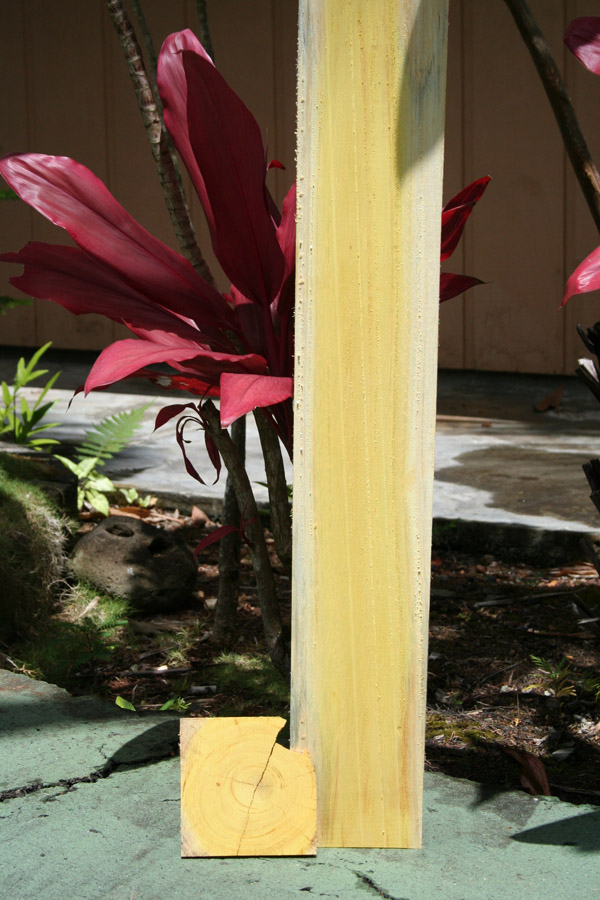
I have often been asked where I get my wood from to make my canoes. One would think that I must be a good customer of the few lumberyards we do have on Oahu or that I must be flying to the Big Island to get my Koa. Well, to be honest, its none of those. Yes, I do buy some veneer on E-bay from time to time, but for the rest nature supplies me most of the wood I need, and this for free. Now if woodworking is your hobby and you wonder where could you could get that ivory looking Tamarind or the golden Jackfruit wood for free, all you need to do is to follow the noise of the chainsaw and find out what kind tree somebody is cutting. You will be surprised how fast you will end up with a huge pile of wood. Here are the wood species I got this way in the last 2 weeks: Koa acacia, Koa formosa, Jack Aranda, Jackfruit, Monkeypod, beautiful wood that would have found its way into the shredder would I not have followed the sound of the chainsaw.

I am just a woodworker

My close friend Keith C. from Guernsey, Channel Islands, told me one day that a good way to avoid being asked to many questions about one’s profession or business is simply to tell people that I am a truck driver and that this is what I do for a living.. Here in Hawaii I have taken habit of saying “I am a woodworker” interesting… Because you see when I say what I am really doing I am afraid to put most people into the embarrassing situation of either having to false praise me for what they think are well made toys, or be at a loss of words when I mention to them the price of those so called toys. Many understand that it takes hours, days, weeks or months to make those canoe models, and few realize that it requires in depth knowledge of the craft or canoe in order to be able to execute a scale model of it. Somehow I feel uneasy talking about my work and prefer the “work” to talk on my behalf. You see, this way I do not inconvenience those who are not interested in canoe models, while still leaving it to admirers and collectors to take pleasure in it. I am just a woodworker whose work will talk well beyond me writing this blog